| name | prompt |
| description | Evaluate, score, or optimize prompts based on Johari Window and 3S principles |
Prompt Scoring Skill
Prompt 评分与优化工具,基于乔哈里视窗理论和 3S 原则,提供自动评分、问题诊断、优化建议和优化版本生成。
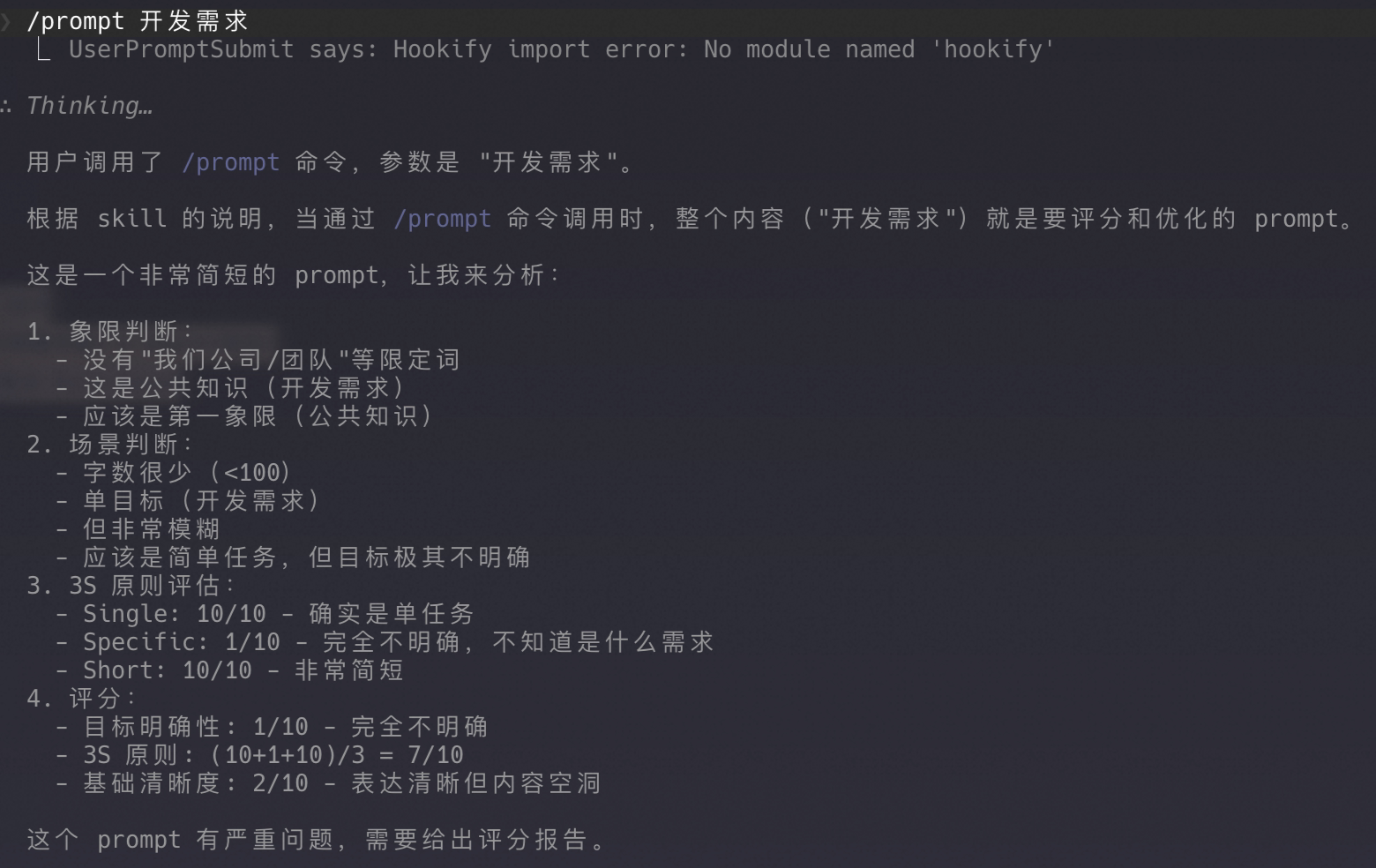
效果:
![https://gw.alicdn.com/imgextra/i4/O1CN01OllFyJ1ph8JrBWAsI_!!6000000005391-2-tps-1560-984.png]
Triggers
TRIGGER when user:
- Explicitly invokes /prompt or /prompt-scoring
- Asks about prompt quality: "这个提示词怎么样", "prompt 写得好吗"
- Requests optimization: "优化这个提示词", "改进这个 prompt"
- Provides text and asks for evaluation: "帮我看看这段 prompt"
AUTO-DETECT (ask before proceeding):
- User input exceeds 200 characters AND looks like a prompt (contains instructions, role definitions, or task descriptions)
- Ask: "检测到你输入了一段较长的提示词,是否需要我进行评分和优化?"
WHEN INVOKED VIA /prompt COMMAND:
- Treat ALL remaining input as the prompt to optimize
- No need to say "优化" explicitly
Invocation Modes
Command Mode (/prompt <content>)
IMPORTANT: When invoked via /prompt command, the ENTIRE content after /prompt is treated as the prompt to optimize. No need to add "优化" or "评分" keywords.
| Input | Behavior |
|---|
/prompt 写一个冒泡排序 | Score and optimize "写一个冒泡排序" |
/prompt 你是一个专业的翻译,请帮我翻译以下内容 | Score and optimize the entire prompt |
/prompt As a senior developer, review my code | Score and optimize the English prompt |
Natural Language Mode
When triggered by implicit keywords in conversation, extract the prompt content from user message.
| Input | Extracted Prompt |
|---|
| "帮我优化一下这个提示词:写一个冒泡排序" | "写一个冒泡排序" |
| "这个 prompt 写得怎么样:你是 AI 助手" | "你是 AI 助手" |
Workflow
Step 0: Auto-Detect Mode (Implicit Trigger)
Detection Criteria:
- Input length > 200 characters
- AND looks like a prompt (contains any of these patterns):
- Role definition: "你是", "你是一个", "As a", "You are"
- Task instruction: "请", "帮我", "请帮我", "Please", "Help me"
- Constraint keywords: "要求", "必须", "注意", "Requirements", "Must"
- Format specification: "输出格式", "返回", "Output format"
Behavior: Ask user before proceeding
检测到你输入了一段较长的提示词,是否需要我进行评分和优化?

[提示词预览]: {前50字}...
- User confirms "是/好/可以" → Proceed to scoring
- User declines "否/不用" → Treat as normal conversation
Step 1: Determine Mode
Input received
├── Starts with "/prompt " → Command Mode
│   └── Extract: everything after "/prompt "
├── Auto-Detect triggered → Auto-Detect Mode (ask first)
│   └── Extract: entire input if user confirms
└── Natural language keywords → Natural Language Mode
    └── Extract: prompt content from message
Step 2-7: Analysis Pipeline
2. Extract Prompt → Get the prompt content to analyze
3. Analyze Prompt → Determine quadrant, 3S compliance, scene type
4. Select Weights → Choose scoring weights based on quadrant and scene
5. Calculate Score → Compute total score (1-10) based on dimensions
6. Diagnose Issues → Identify Critical/High/Medium/Low problems
7. Generate Optimized Version → Create improved prompt
Core Theory
Johari Window (乔哈里视窗四象限)
                    AI Knows                AI Doesn't Know
User Knows      第一象限(公共知识)        第四象限(独有知识) ⚠️
User Doesn't    第二象限(AI专业知识)      第三象限(探索创新)
Know
Critical: 第四象限识别
检测标识 (有则可能是第四象限):
- 包含"我们团队"、"我们公司"、"本项目"等限定词
- 包含内部系统名称、团队黑话/缩写
- 包含新定义概念,且无示例、无定义
处理规则:
- 如果是第四象限但未使用"喂模式"(举例法/定义字典/RAG): 总分 ≤ 2.0/10 (Critical 级别)
- 正确使用喂模式: 可提升至 7.0-8.5/10
3S Principles
| Principle | Meaning | Detection |
|---|
| Single | 单任务聚焦 | 检测"和"、"并"、"以及"等连接词,多个动词短语 |
| Specific | 明确详细 | 有格式+范围+示例: 9-10分; 有格式有范围: 7-8分; 无格式无范围: 2-6分 |
| Short | 简洁扼要 | 无冗余、高信息密度: 9-10分; 冗余修饰、低密度: 4-6分 |
Scoring System
Scene Detection
| Scene | Conditions | Weight Distribution |
|---|
| 简单任务 | 字数<100, 单目标, 无复杂结构 | 目标明确性 40% + 3S原则 30% + 基础清晰度 30% |
| 复杂专业 | Role-Based, 工作流, 约束 | 基础评分 50% + 深度评分 50% |
| 第四象限 | 独有知识, 企业术语, 新概念 | 目标明确性 20% + 示例/术语完整性 80% |
| 学习任务 | 学习、理解、解释关键词 | 目标明确性 30% + 3S原则 30% + 表达清晰度 40% |
Scoring Dimensions
基础评分 (所有 Prompt)
- 目标明确性 (40%): 目标清晰? 有成功标准? 范围明确?
- 3S 原则 (30%): Single/Specific/Short
- 基础清晰度 (30%): 语言表达清晰? 逻辑结构合理?
深度评分 (条件触发)
触发条件: 复杂专业任务 OR 第四象限 OR 包含 Role-Based 结构 OR 字数 > 200
- 约束完整性 (25%): 约束必要/可验证/无冲突
- 技能匹配度 (25%): Role/Skills 匹配任务
- 工作流清晰度 (25%): 步骤逻辑清晰/可重复执行
- 示例/术语完整性 (25%): 示例完整/术语有定义
Problem Diagnosis
Critical Level (必须修复)
| # | Problem Type | Detection | Impact |
|---|
| 1 | 第四象限未使用喂模式 | 第四象限但无示例/定义 | AI无法理解独有知识 |
| 2 | 多目标混杂 | Single原则违背,多个目标 | AI无法确定主要目标 |
| 3 | 完全缺少成功标准 | 无输出要求、无验证标准 | 无法判断是否完成 |
High Level (强烈建议修复)
| # | Problem Type | Detection |
|---|
| 4 | 约束互相冲突 | 约束之间互相矛盾 |
| 5 | 技能与任务不匹配 | Role/Skills 与任务无关 |
| 6 | 示例不完整 | 第四象限示例缺少输入/输出/模式 |
Medium Level (建议优化)
| # | Problem Type | Detection |
|---|
| 7 | 过度设计(第一象限) | 第一象限使用复杂 Role-Based 结构 |
| 8 | 缺少部分成功标准 | 有成功标准但不完整 |
| 9 | 约束不够具体 | 约束模糊无法验证 |
Low Level (可选优化)
| # | Problem Type |
|---|
| 10 | 格式不规范 |
| 11 | 表达不够简洁 |
Optimization Strategies
Strategy Selection
| Condition | Strategy | Method |
|---|
| 问题少(≤3), 无Critical | 保留式优化 | 保留原有结构风格,只修改问题部分 |
| 问题多(>3), 有Critical | 重构式优化 | 重新设计结构,应用合适模板 |
| 完全不匹配最佳实践 | 模板化优化 | 推荐最合适模板,基于模板重新构建 |
Output Format
Standard Report Structure
## Prompt 评分报告

### 基本信息
- **象限**: [第一/二/三/四象限]
- **场景**: [简单/复杂/第四象限/学习任务]
- **总分**: X/10

### 各维度得分
1. **目标明确性**: X/10 - [简要说明]
2. **3S 原则**: X/10
   - Single: X/10
   - Specific: X/10
   - Short: X/10
3. **基础清晰度**: X/10

### 问题诊断
[按严重性排序:Critical > High > Medium > Low]

#### [问题 1]
- **等级**: Critical
- **类型**: [问题类型]
- **描述**: [问题详细说明]

### 优化建议
- **针对问题**: [问题 X]
- **优化方向**: [具体建议]
- **预期改进**: 评分提升 X/10 → X/10

### 优化版本
[基于优化建议生成的完整 Prompt]
Examples
Example 1: Command Mode
Input: /prompt 写一个冒泡排序
Mode: Command Mode - entire input "写一个冒泡排序" is the prompt to optimize
Analysis:
- 象限: 第一象限
- 场景: 简单任务
- 3S: Single(10/10), Specific(7/10), Short(9/10)
Score: 7.9/10
Issues: Medium - 缺少性能要求
Optimized:
用 Python 实现快速排序算法:
- 输入:整数列表
- 输出:升序排列的列表
- 要求:时间复杂度 O(n log n),空间复杂度 O(log n)
Example 2: Natural Language Mode
Input: "帮我优化这个提示词:审查我们公司的 XYZ 系统代码,确保遵循 YYY 规范"
Mode: Natural Language Mode - extract "审查我们公司的 XYZ 系统代码,确保遵循 YYY 规范"
Analysis:
- 象限: 第四象限 (人知 AI 不知)
- 问题: 未使用喂模式
Score: 2.0/10 (Critical)
Optimized (8.5/10):
审查我们公司的 XYZ 系统代码,确保遵循 YYY 规范。

**定义**:
- XYZ 系统:我们内部的微服务框架,基于 Spring Boot
- YYY 规范:内部代码规范,要求类名用 PascalCase,方法名用 camelCase

**示例**:
❌ 不符合规范:
public class user_service { }

✅ 符合规范:
public class UserService { }
Quick Reference
Quadrant Decision Tree
包含限定词("我们公司/团队")?
├─ 是 → 第四象限 (需要喂模式)
└─ 否 → 开放提问?
         ├─ 是 → 第二象限
         └─ 否 → 探索创新?
                  ├─ 是 → 第三象限
                  └─ 否 → 第一象限
Score Interpretation
| Score | Quality | Action |
|---|
| 9-10 | 优秀 | 可直接使用 |
| 7-8.9 | 良好 | 建议小优化 |
| 5-6.9 | 一般 | 建议优化 |
| 3-4.9 | 较差 | 需要重构 |
| 1-2.9 | 严重问题 | 必须重写 |
Best Practices
- 第四象限必须用喂模式: 举例法、定义字典、RAG 技术
- 遵循 3S 原则: Single(单任务) + Specific(明确详细) + Short(简洁)
- 第一象限避免过度设计: 公共知识直接描述,无需复杂 Role-Based
- 明确成功标准: 定义输出格式和验证标准
- 约束要可验证: 避免模糊的约束条件
Limitations
- 中文优化为主,英文 Prompt 评分可能有偏差
- 主观性评分,仅供参考
- 需要结合具体场景判断