| name | iblai-vibe-course-access |
| description | Add course-content pages (edX user UI) to your Next.js app |
| globs | null |
| alwaysApply | false |
/iblai-vibe-course-access
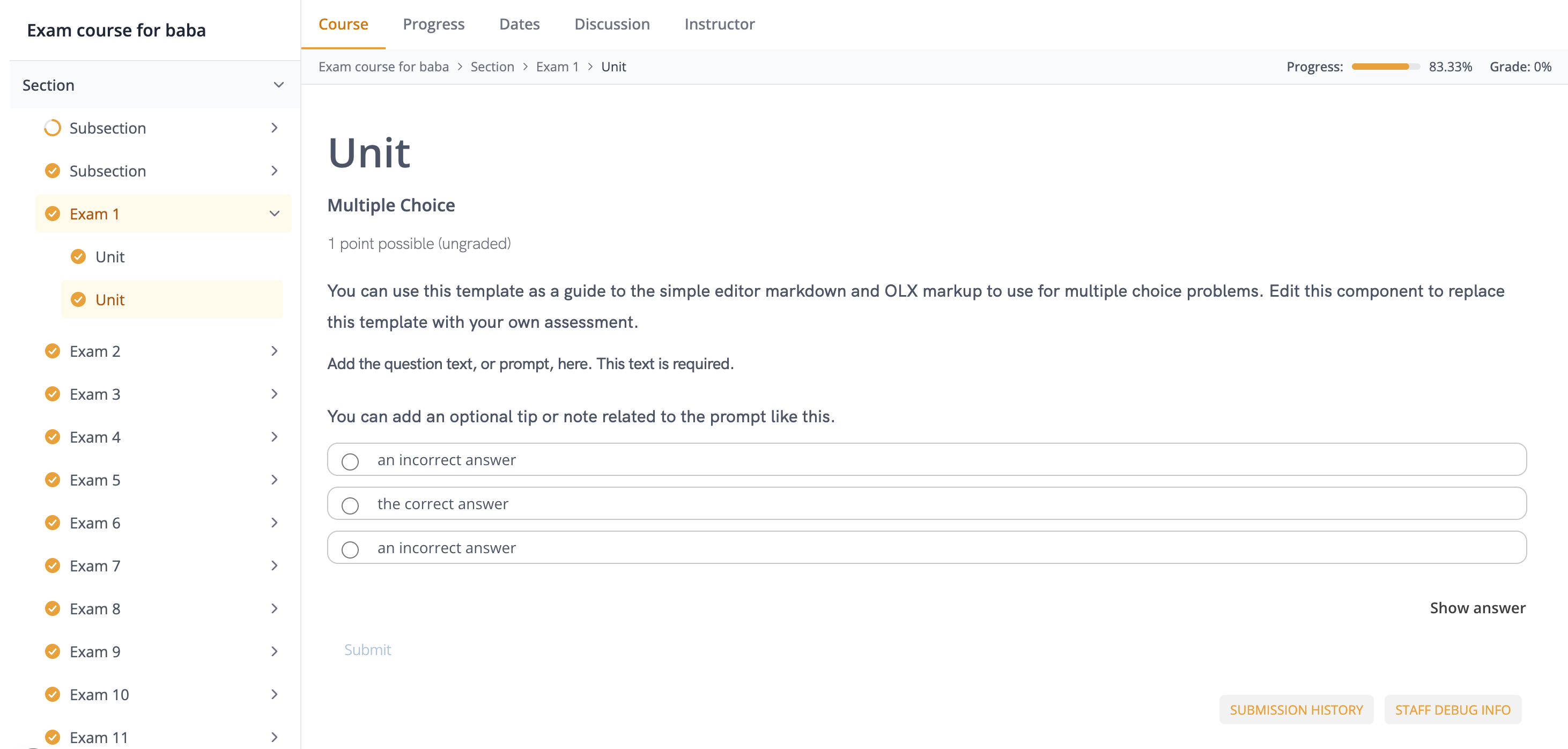
Add a full edX course-content experience -- hierarchical course outline
sidebar, collapsible modules/lessons/sublessons with progress indicators,
top tab strip (Course, Progress, Dates, Discussion, Instructor), breadcrumb
- progress bar header, embedded learning MFE / LMS iframe with JWT
postMessage handshake, previous / next unit navigation, timed-exam guard,
and tenant-based access control. Pulls course metadata, outline,
completion, and grading data via the data-layer RTK Query hooks.
Do NOT add custom styles, colors, or CSS overrides to ibl.ai SDK components.
They ship with their own styling. Keep the components as-is.
Do NOT implement dark mode unless the user explicitly asks for it.
When building custom UI around SDK components, use the ibl.ai brand:
- Primary:
#0058cc, Gradient: linear-gradient(135deg, #00b0ef, #0058cc)
- Button:
bg-gradient-to-r from-[#2563EB] to-[#93C5FD] text-white
- Font: System sans-serif stack, Style: shadcn/ui new-york variant
- Follow the component hierarchy: use ibl.ai SDK components
(
@iblai/iblai-js) first, then shadcn/ui for everything else
(npx shadcn@latest add <component>). Do NOT write custom components
when an ibl.ai or shadcn equivalent exists. Both share the same
Tailwind theme and render in ibl.ai brand colors automatically.
- Follow BRAND.md for
colors, typography, spacing, and component styles.
You MUST run /iblai-vibe-ops-test before telling the user the work is ready.
After all work is complete, start a dev server (pnpm dev) so the user
can see the result at http://localhost:3000.
iblai.env is NOT a .env.local replacement — it only holds the 3
shorthand variables (DOMAIN, PLATFORM, TOKEN). Next.js still reads
its runtime env vars from .env.local.
Use pnpm as the default package manager. Fall back to npm if pnpm
is not installed. The generated app should live in the current directory,
not in a subdirectory.
Common setup (brand, conventions, env files, verification): see docs/skill-setup.md.
Prerequisites
- Auth must be set up first (
/iblai-vibe-auth)
- MCP server + skills configured (
@iblai/mcp in .mcp.json)
- A valid edX course id (e.g.
course-v1:org+course+run). The user must
already have a course published on their tenant. If not, direct them to
their LMS Studio to create one.
Step 1: Check Environment
Before proceeding, check for a iblai.env
in the project root. Look for PLATFORM, DOMAIN, and TOKEN variables.
If the file does not exist or is missing these variables, tell the user:
"You need an iblai.env with your platform configuration. Download the
template and fill in your values:
curl -o iblai.env https://raw.githubusercontent.com/iblai/vibe/refs/heads/main/iblai.env"
You will also need the following in .env.local for the learning MFE / LMS
iframes to load correctly:
NEXT_PUBLIC_LMS_URL=https://lms.<your-platform>.iblai.app
NEXT_PUBLIC_MFE_URL=https://learning.<your-platform>.iblai.app
NEXT_PUBLIC_LEGACY_LMS_URL=https://lms.<your-platform>.iblai.app
NEXT_PUBLIC_DM_URL=https://dm.<your-platform>.iblai.app
Architecture
Course-content ships as SDK components with no CLI generator -- you wire
the pages yourself, similar to /iblai-vibe-workflow and /iblai-vibe-analytics.
Four files cover a production-quality course player:
app/(app)/course-content/
└── [course_id]/
    ├── layout.tsx                  # Wraps pages in CourseContentLayout
    ├── course/page.tsx             # Course body (default tab)
    ├── progress/page.tsx           # Progress tab
    ├── dates/page.tsx              # Dates tab
    ├── discussion/page.tsx         # Forum (route segment differs from tab)
    └── instructor/page.tsx         # Instructor tab (admin only)
The layout mounts CourseContentLayout, which owns the outline sidebar,
breadcrumb header, tab strip, and the two contexts (CourseOutlineContext,
EdxIframeContext). Each per-tab page.tsx renders a CourseContentTabPage
that shares those contexts via the surrounding layout.
Step 2: SDK Imports
Import course-content components directly. The framework-agnostic pieces
(outline, drawer, timed-exam, guard, loading, hooks, contexts, types) come
from @iblai/iblai-js/web-containers. The three Next-specific pieces
(CourseContentLayout, CourseContentTabPage, EdxIframe) come from
@iblai/iblai-js/web-containers/next because they import next/navigation
and next/link.
import {
CourseOutline,
CourseOutlineDrawer,
CourseAccessGuard,
CourseContentLoading,
TimedExam,
CourseOutlineContext,
EdxIframeContext,
useCourseDetail,
useEdxIframe,
useCourseNavigator,
} from "@iblai/iblai-js/web-containers";
import {
CourseContentLayout,
CourseContentTabPage,
EdxIframe,
} from "@iblai/iblai-js/web-containers/next";
import {
useGetDepartmentMemberCheckQuery,
useLazyGetExamInfoQuery,
useCreateCourseEnrollmentMutation,
useCreateStripeCheckoutSessionMutation,
useLazyGetCourseCompletionQuery,
useLazyGetCourseProgressQuery,
} from "@iblai/iblai-js/data-layer";
Step 3: Create the Layout
app/(app)/course-content/[course_id]/layout.tsx — mounts
CourseContentLayout, which renders the outline sidebar, tab strip, and
breadcrumb, and provides both course-content contexts to children.
"use client";

import type React from "react";
import { useCallback } from "react";
import { useParams, useRouter } from "next/navigation";
import { CourseContentLayout } from "@iblai/iblai-js/web-containers/next";
import { useGetDepartmentMemberCheckQuery } from "@iblai/iblai-js/data-layer";
import { toast } from "sonner";

import { resolveAppTenant } from "@/lib/iblai/tenant";

export default function CourseContentLayoutWrapper({
  children,
}: { children: React.ReactNode }) {
  const params = useParams<{ course_id: string }>();
  const router = useRouter();
  const courseId = decodeURIComponent(params.course_id);
  const tenant = resolveAppTenant();

  const { data: adminCheck } = useGetDepartmentMemberCheckQuery({
    platform_key: tenant,
  });
  const isPlatformAdmin = Boolean(adminCheck?.is_admin);

  const handleNavigate = useCallback(
    (href: string, opts?: { external?: boolean }) => {
      if (opts?.external) {
        window.location.href = href;
      } else {
        router.push(href);
      }
    },
    [router],
  );

  return (
    <CourseContentLayout
      courseId={courseId}
      currentTenant={tenant}
      isPlatformAdmin={isPlatformAdmin}
      dmUrl={process.env.NEXT_PUBLIC_DM_URL ?? ""}
      courseEligibilityEnabled
      onUnauthorized={() => router.push("/error/403")}
      onNotFound={() => router.push("/error/404")}
      onNavigate={handleNavigate}
      onError={(msg) => toast.error(msg)}
      onSuccess={(msg) => toast.success(msg)}
      onCourseMentorChange={(uuid) => {
        // Optional: wire the course's attached mentor into your chat widget
      }}
    >
      {children}
    </CourseContentLayout>
  );
}
Key patterns
isPlatformAdmin gates the Instructor tab. Derive it from
useGetDepartmentMemberCheckQuery({ platform_key: tenant }) — the layout
does NOT read it itself.onUnauthorized / onNotFound: the layout never calls router.push
directly. Wire these to your error routes. Wrap them in useCallback
(or hoist to module scope) so CourseAccessGuard doesn't refire them.onNavigate: the layout calls this for lesson open, access course,
and Stripe checkout redirects. opts.external === true means full-page
navigation; otherwise use router.push.dmUrl: required for the Stripe success_url returned by
useCourseDetail. Read from NEXT_PUBLIC_DM_URL.courseEligibilityEnabled: pass true to opt into the richer
enrollment / eligibility branch (Enroll Now / Buy Now / Request Access
labels). Pass false / omit for the simple "Access Course" branch.
Step 4: Create the Per-Tab Pages
Each tab is its own Next.js route. They all render CourseContentTabPage,
which mounts EdxIframe and signals the active tab to
EdxIframeContext (wired by the layout).
Note the route segment / tab-value mismatch: the forum tab is served at
/discussion. The default tabHrefTemplate in the layout maps
forum → discussion. If you use a different base path, override
tabHrefTemplate.
app/(app)/course-content/[course_id]/course/page.tsx
"use client";

import { CourseContentTabPage } from "@iblai/iblai-js/web-containers/next";

const iframeProps = {
  lmsUrl: process.env.NEXT_PUBLIC_LMS_URL ?? "",
  mfeUrl: process.env.NEXT_PUBLIC_MFE_URL ?? "",
  legacyLmsUrl: process.env.NEXT_PUBLIC_LEGACY_LMS_URL ?? "",
};

export default function CoursePage() {
  return <CourseContentTabPage tab="course" {...iframeProps} />;
}
Remaining tabs
| Route | tab value |
|---|
/course-content/[course_id]/course | "course" |
/course-content/[course_id]/progress | "progress" |
/course-content/[course_id]/dates | "dates" |
/course-content/[course_id]/discussion | "forum" |
/course-content/[course_id]/instructor | "instructor" |
Each page is identical except for the tab prop. The instructor page does
NOT self-gate non-admin viewers — the layout hides the tab button when
isPlatformAdmin is false, but a direct URL visit will still render.
If you need a hard gate, wrap the page in your own admin guard.
Step 5: Use MCP Tools for Customization
get_component_info("CourseContentLayout")
get_component_info("CourseContentTabPage")
get_component_info("EdxIframe")
get_component_info("CourseOutline")
get_hook_info("useCourseDetail")
get_hook_info("useEdxIframe")
get_hook_info("useCourseNavigator")
<CourseContentLayout> Props
Next-specific. Owns CourseOutlineContext + EdxIframeContext.
Required
| Prop | Type | Description |
|---|
courseId | string | edX course id (the [course_id] path param) |
isPlatformAdmin | boolean | Whether the viewer is an admin on the current tenant (gates the instructor tab) |
currentTenant | string | Tenant / platform key the viewer operates in |
dmUrl | string | LMS data-management base URL — used to build the Stripe success_url |
children | ReactNode | Per-tab content (typically a CourseContentTabPage) |
Optional
| Prop | Type | Description |
|---|
tabHrefTemplate | (args: { courseId: string; tab: string }) => string | Override the per-tab href. Defaults to /course-content/${courseId}/${routeSegment} |
onUnauthorized | () => void | Fired when the viewer's tenant can't see the course |
onNotFound | () => void | Fired when the course fetch fails |
onNavigate | (href: string, opts?: { external?: boolean }) => void | Wires lesson open, access course, and Stripe checkout redirects |
onError | (message: string) => void | Toaster hook for failures |
onSuccess | (message: string) => void | Toaster hook for successes |
courseEligibilityEnabled | boolean | Opt into the richer eligibility branch (Enroll Now / Buy Now / Request Access) |
onCourseMentorChange | (mentorUuid: string | null) => void | Fires when the fetched course exposes a mentor_uuid and isn't mentor_hidden — wire to your chat widget |
<CourseContentTabPage> Props
Next-specific. Renders <EdxIframe /> inside the layout's
EdxIframeContext and sets the active tab.
| Prop | Type | Description |
|---|
tab | "course" | "dates" | "progress" | "bookmarks" | "forum" | "instructor" | Which edX tab this page represents |
lmsUrl | string | LMS base URL |
mfeUrl | string | User MFE base URL |
legacyLmsUrl | string | Legacy LMS base URL |
edxTokenKey | string? | localStorage key for the edX JWT token. Defaults to "edx_jwt_token" |
sandbox | string? | iframe sandbox attribute. Defaults to the permissive set for the learning MFE |
<EdxIframe> Props
Next-specific. Used directly only if you render the iframe outside the
standard tab page flow. Otherwise, prefer CourseContentTabPage.
Same props as CourseContentTabPage minus tab.
<CourseOutline> Props
Framework-agnostic. Reads everything from CourseOutlineContext — no
props. Rendered automatically by CourseContentLayout (desktop sidebar +
mobile drawer). Use it directly only if you build a custom layout; wrap it
in a <CourseOutlineContext.Provider value={...} />.
<CourseOutlineDrawer> Props
Framework-agnostic. Mobile drawer wrapping CourseOutline in a Sheet.
Also context-driven — no props.
<CourseAccessGuard> Props
Framework-agnostic. Gates children on a clean authorized load. Used
internally by CourseContentLayout but exposed for custom shells.
| Prop | Type | Description |
|---|
course | CourseEdxData | null | From useCourseDetail |
courseInfoLoadingState | "not-started" | "loading" | "successful" | "failure" | From useCourseDetail |
currentTenant | string | Platform key the viewer operates in |
onUnauthorized | () => void | Fires once when the course's platform_key is neither "main" nor currentTenant |
onNotFound | () => void | Fires once when the course fetch fails |
children | ReactNode | Rendered only on a clean authorized load |
Wrap onUnauthorized / onNotFound in useCallback (or hoist to module
scope) to avoid spurious re-fires.
<TimedExam> Props
Framework-agnostic. Renders the timed-exam blocker overlay when the current
subsection is a proctored exam. Reads from EdxIframeContext — no props.
Rendered automatically by EdxIframe.
<CourseContentLoading> Props
Framework-agnostic. Full-height spinner skeleton. No props. Use as a
Next loading.tsx export:
"use client";
import { CourseContentLoading } from "@iblai/iblai-js/web-containers";
export default CourseContentLoading;
Hooks
All framework-agnostic (import from @iblai/iblai-js/web-containers).
useCourseDetail({ courseId, dmUrl, courseEligibilityEnabled?, onNavigate?, onError?, onSuccess? })
Returns the fetched course metadata, outline, completion, progress,
grading policy, and a set of handlers (handleFetchCourseInfo,
handleFetchCourseSyllabus, handleOpenLesson, handleFetchCourseProgress,
handleFetchCourseCompletion, handleCourseAction, etc.). Used
internally by CourseContentLayout — you typically don't call it
yourself.
useEdxIframe({ lmsUrl, mfeUrl, legacyLmsUrl })
Returns getIframeURL, findSequentialParent, getUnitToIframe, and
getParentsInfosFromSublessonId. Used internally by EdxIframe.
useCourseNavigator(courseOutline, currentUnitId)
Returns a navigator with moveToPrevious(), moveToNext(),
isPreviousHidden(), isNextHidden(), plus the flattened
thirdLevelChildren index. Used internally by EdxIframe for the
previous / next unit buttons.
Contexts
Both framework-agnostic.
CourseOutlineContext
Exposes courseOutline, courseOutlineLoading, expandedModule,
expandedLessons, selectLesson, toggleModule, toggleLesson,
currentChapter, currentLesson, course, courseOutlineDrawerOpen,
setCourseOutlineDrawerOpen, currentUnitID, refetchCourseOutline.
Set up by CourseContentLayout.
EdxIframeContext
Exposes iframeUrl, setIframeUrl, courseOutline, activeTab,
setActiveTab, courseID, currentlyInExamSubsection,
setCurrentlyInExamSubsection, examInfo, setExamInfo, refresher,
setRefresher. Set up by CourseContentLayout.
Custom Routing
If your app doesn't live at /course-content/[course_id], override
tabHrefTemplate:
<CourseContentLayout
tabHrefTemplate={({ courseId, tab }) => {
const segmentMap: Record<string, string> = {
course: "content",
progress: "progress",
dates: "schedule",
forum: "discussion",
instructor: "admin",
};
return `/learn/${courseId}/${segmentMap[tab] ?? tab}`;
}}
>
{children}
</CourseContentLayout>
The tab value passed to CourseContentTabPage stays the same
(e.g. "forum"); only the route segment changes.
Step 6: Redux Store
@iblai/iblai-js/data-layer ships coreApiSlice, mentorReducer, and
mentorMiddleware — you already have them if you ran /iblai-vibe-auth.
No additional slices are required for course-content. The hooks used
internally (useGetExamInfoQuery, useGetCourseCompletionQuery,
useGetCourseProgressQuery, useCreateCourseEnrollmentMutation,
useCreateStripeCheckoutSessionMutation) all live on coreApiSlice.
Verify your store/iblai-store.ts includes:
import {
  coreApiSlice,
  mentorReducer,
  mentorMiddleware,
} from "@iblai/iblai-js/data-layer";

export const store = configureStore({
  reducer: {
    [coreApiSlice.reducerPath]: coreApiSlice.reducer,
    mentor: mentorReducer,
  },
  middleware: (getDefaultMiddleware) =>
    getDefaultMiddleware()
      .concat(coreApiSlice.middleware)
      .concat(mentorMiddleware),
});
Without mentorReducer / mentorMiddleware, the course-content hooks
silently return undefined.
Step 7: Verify
Run /iblai-vibe-ops-test before telling the user the work is ready:
pnpm build — must pass with zero errorspnpm test — vitest must pass- Start dev server and touch test:
pnpm dev &
npx playwright screenshot "http://localhost:3000/course-content/<course-id>/course" /tmp/course.png
Replace <course-id> with a URL-encoded course id the user has access
to (e.g. course-v1%3Aibl%2BDEMO%2B2024).
Common Pitfalls
-
forum tab at /discussion: The route segment is discussion,
the tab value is "forum". The default tabHrefTemplate handles this
mapping. If you override tabHrefTemplate, preserve the mapping.
-
Instructor page not gated by default: CourseContentLayout hides
the instructor tab button when isPlatformAdmin is false, but the
route itself is not self-guarded. A non-admin visiting the URL directly
will still render the iframe. Wrap the page in your own guard if you
need a hard gate.
-
onUnauthorized / onNotFound re-fires: Stabilize these with
useCallback — otherwise CourseAccessGuard's effect will re-run on
every render and push twice.
-
dmUrl missing: Required for Stripe checkout's success_url.
Without it, the paid-enrollment branch of useCourseDetail throws.
-
platform_key: "main" exception: CourseAccessGuard always allows
courses whose platform_key === "main". This is intentional — global
catalog courses bypass the tenant check.
-
iframe JWT postMessage: EdxIframe listens for auth.jwt.ready from
the MFE and replies with the JWT stored at edxTokenKey
("edx_jwt_token" by default). If you use a custom localStorage key,
pass it via edxTokenKey on every CourseContentTabPage.
-
mentor_hidden suppresses onCourseMentorChange: If a course has
mentor_hidden: true, the callback is never fired — do not wire
fallback agents from the caller side.
-
useCourseDetail is internal: Don't call it from pages — the
layout already calls it and exposes state via CourseOutlineContext.
Calling it again creates duplicate fetches and stale state.
Important Notes
- Import paths: framework-agnostic from
@iblai/iblai-js/web-containers,
Next-specific (CourseContentLayout, CourseContentTabPage, EdxIframe)
from @iblai/iblai-js/web-containers/next.
- Redux store: must include
mentorReducer and mentorMiddleware
initializeDataLayer(): 5 args (v1.2+)@reduxjs/toolkit: deduplicated via webpack aliases in next.config.ts- Env vars:
NEXT_PUBLIC_LMS_URL, NEXT_PUBLIC_MFE_URL,
NEXT_PUBLIC_LEGACY_LMS_URL, NEXT_PUBLIC_DM_URL
- Brand guidelines: BRAND.md
