<p align="center">
<a href="https://three.ws"><img src="https://three.ws/three-ws-mcp-icon.svg" width="72" height="72" alt="three.ws" /></a>
</p>
<h1 align="center">@three-ws/motion</h1>
<p align="center"><strong>Text and structure to full-body 3D animation. No motion capture, no model weights, no renderer.</strong></p>
<p align="center">
<a href="https://www.npmjs.com/package/@three-ws/motion"><img alt="npm" src="https://img.shields.io/npm/v/@three-ws/motion?logo=npm&color=cb3837"></a>
<a href="https://www.npmjs.com/package/@three-ws/motion"><img alt="downloads" src="https://img.shields.io/npm/dm/@three-ws/motion?color=cb3837"></a>
<img alt="license" src="https://img.shields.io/npm/l/@three-ws/motion?color=3b82f6">
<img alt="node" src="https://img.shields.io/node/v/@three-ws/motion?color=339933&logo=node.js">
<img alt="dependencies" src="https://img.shields.io/badge/dependencies-0-3b82f6">
</p>
<p align="center">
<a href="#install">Install</a> ·
<a href="#quick-start">Quick start</a> ·
<a href="#the-motion-score">Motion Score</a> ·
<a href="#api">API</a> ·
<a href="#cli">CLI</a> ·
<a href="#how-it-works">How it works</a> ·
<a href="https://three.ws/motion">three.ws/motion</a>
</p>
---
Every other way to get a new animation needs data you do not have: a motion
capture stage, a licensed clip library, or a diffusion model trained on one.
This package needs a sentence.
```js
import { motionFromText } from '@three-ws/motion';
const { clip } = motionFromText('wave hello twice, excitedly');
// clip is a three.js AnimationClip.toJSON() document, ready to play
```
It works because a human body is a solved kinematics problem. Give a solver the
places a body should be at a few moments in time, plus how it should get there,
and it can produce the joint rotations for every frame between, with the feet on
the floor, the weight over them, and the shoulders doing what shoulders do. The
hard part was never the math, it was the authoring format, and that is what a
**Motion Score** is: an animation written in anatomy and timing rather than in
quaternions, which means a language model can write one and a person can read
the diff.
## Why
- **Nothing to download.** No `.fbx` library, no weights, no GPU. Zero
dependencies, and it runs in a browser tab, a Node script, or a serverless
handler from the same code path.
- **Deterministic.** The same score compiles to the same clip, byte for byte,
forever. Cacheable, diffable, and regression-testable.
- **It plays on anything humanoid.** The output is standard clip JSON with
canonical bone names, so it retargets onto Mixamo, Avaturn, VRM, Ready Player
Me, Unreal and Daz rigs through any retargeter that speaks them.
- **It knows about bodies.** Feet stay on the floor, the centre of mass stays
over the support base, the clavicle helps a long reach, and the whole thing
breathes. Those are the four things that separate a synthesized motion from a
mannequin changing shape.
## Install
```bash
npm install @three-ws/motion
```
## Quick start
### From a prompt
```js
import { motionFromText } from '@three-ws/motion';
import { AnimationClip, AnimationMixer } from 'three';
const { clip, score, matched } = motionFromText('sit down heavily');
const mixer = new AnimationMixer(avatar);
mixer.clipAction(AnimationClip.parse(clip)).play();
```
`motionFromText` uses the built-in lane, which recognizes about twenty actions
with their modifiers (side, direction, manner, repetition) and needs no network
and no API key. It throws `code: 'unrecognized_motion'` for anything outside
that vocabulary, which is the signal to hand the prompt to a model instead.
### From a model
Give any tool-calling model `scoreSchema()` and let it author the score. Every
enum in the schema is generated from the same vocabulary the solver reads, so a
model cannot invent a word the compiler will reject.
```js
import { compileScore, scoreSchema } from '@three-ws/motion';
const score = await yourModel.json({
system: 'Write a Motion Score for the described movement.',
user: 'She looks up from her desk, considers it, then shakes her head slowly.',
schema: scoreSchema(),
});
const { clip, warnings } = compileScore(score);
```
### By hand
```js
import { compileScore } from '@three-ws/motion';
const { clip } = compileScore({
name: 'thinking it over',
beats: [
{ label: 'still', posture: 'easy', hold: 0.4 },
{
label: 'hand to chin',
posture: 'easy',
arms: { right: { at: 'chin', palm: 'in', hand: 'loose', elbow: 'down' } },
gaze: 'aside',
face: 'focused',
in: 0.5,
hold: 1.2,
},
{ label: 'decides', posture: 'proud', gaze: 'forward', face: 'smile', in: 0.45, hold: 0.5 },
],
});
```
## The Motion Score
A score is a list of **beats**. A beat is where the body is at one instant, how
long it takes to get there (`in`), and how long it stays (`hold`). Nothing in it
is a bone name.
```json
{
"name": "greeting",
"loop": false,
"effort": "playful",
"beats": [
{ "posture": "easy", "hold": 0.2 },
{
"label": "hand up",
"posture": "easy",
"arms": { "right": { "at": "overhead", "up": -0.08, "palm": "forward", "hand": "open", "elbow": "out" } },
"gaze": "forward",
"face": "smile",
"in": 0.36,
"hold": 0.1
},
{ "label": "lower", "arms": { "right": { "at": "side", "hand": "relaxed" } }, "in": 0.5, "hold": 0.2 }
]
}
```
| Field | What it says |
| --------- | ----------------------------------------------------------------------------------------------- |
| `posture` | a whole-body shape (`stand`, `crouch`, `sit`, `lunge`, `bow`, `tiptoe`, …) that seeds the rest |
| `root` | hip `height` as a fraction of standing, plus `forward` / `side` travel, `rise`, and `turn` |
| `torso` | `lean`, `twist`, `sideBend`, in degrees, distributed along the spine |
| `arms` | per side: an anchor (`chin`, `sternum`, `overhead`, `thigh`, `front`, …), offsets, palm, hand |
| `legs` | a `stance`, or per-foot placement with `plant` (`flat`, `toe`, `heel`, `lift`) |
| `gaze` | a named look, or explicit `yaw` / `pitch` |
| `face` | a named expression, mapped to ARKit blendshape weights |
| `effort` | how it is performed: `weight`, `time`, `flow`, or a preset like `sharp` / `weary` / `sustained` |
**Effort is not decoration.** It picks the easing curve, scales the travel time,
and sets how far a limb overshoots before it settles, which is what makes the
same three shapes read as a wave, a swat, or a salute.
The full field reference is
[specs/MOTION_SCORE.md](https://github.com/nirholas/three.ws/blob/main/specs/MOTION_SCORE.md).
## API
| Export | What it does |
| ------------------------------- | ------------------------------------------------------------------------ |
| `motionFromText(prompt, opts)` | prompt to `{ clip, score, matched, warnings }`, no model needed |
| `compileScore(score, opts)` | score to `{ clip, score, warnings }` |
| `validateScore(input)` | `{ ok, score, error }` with the exact path that failed |
| `normalizeScore(input)` | the same, but throws |
| `scoreSchema()` | JSON Schema for a tool call, generated from the live vocabulary |
| `motionCapabilities()` | schema, limits, and known actions in one object |
| `composeScore(prompt, opts)` | the model-free lane on its own, returning a raw score |
| `describeScore(score)` | one readable line: duration, beats, and what happens |
| `solveBeat(beat)` | one beat to a solved `Pose` |
| `buildClip(keys, opts)` | solved poses to a clip document |
`compileScore` options: `idle` (breathing and micro-sway, default on),
`rootMotion` (the hip translation track, default on, turn off for a clip that
must play in place), `fingers` (default on).
The kinematics layer is exported too, for callers building an editor or a
different authoring format:
```js
import { restPose, solveArm, solveLeg, solveSpine, anchorPoint, centreOfMass } from '@three-ws/motion';
const pose = restPose();
solveArm(pose, 'Right', { wrist: anchorPoint(pose, 'chin', { side: 'Right' }), palm: [0, 0, 1] });
```
Or import it on its own, with none of the score machinery:
```js
import { Pose, solveTwoBone, BODY_FORWARD } from '@three-ws/motion/rig';
```
## CLI
```bash
npx @three-ws/motion "wave hello twice, excitedly" -o wave.json
npx @three-ws/motion --score sit.json --no-idle --no-root -o sit.json
npx @three-ws/motion --schema # the score schema, for a tool call
npx @three-ws/motion --actions # what the model-free lane knows
```
## How it works
Each beat is solved in an order that matters:
```
root where the hips are, which everything below hangs from
turn the body's heading, so limbs solve in the turned frame
torso lean, twist, side-bend, shared along the spine
legs ankles placed in WORLD space, so dropping the hips bends the knees
balance the hips nudged until the centre of mass sits over the feet
arms wrists placed against anchors that ride the posed chest
hands shape, after the wrist is where it belongs
gaze last, so a look is relative to the chest it ended up on
```
Reverse any two and the result is subtly wrong in a way that is impossible to
fix downstream. Solve the arms before the torso and every gesture sits where the
chest used to be. Solve the legs before the root and a crouch drives the feet
through the floor.
Four details do most of the work:
- **Feet are placed against the floor, not against the hips.** The hips are free
to drop, lean and turn; the legs absorb it through IK, which is what a real
body does and why a crouch looks like a crouch.
- **Balance is measured, not assumed.** The centre of mass is a mass-weighted
sum over the segments that carry a body's weight, and the hips are moved until
it sits over whichever feet are carrying weight. A lifted foot carries none,
so a single-leg beat shifts the body over the standing leg on its own.
- **The clavicle helps.** An arm is not two bones on a fixed socket. The
shoulder girdle swings toward a distant target, which is worth ten to fifteen
centimetres of reach and most of what makes a reach read as a whole body
reaching.
- **Easing is baked as geometry.** A mixer slerps between quaternion keys
linearly, so an ease named in the score has to exist as extra samples in the
track or it is not there at all.
The reference skeleton is measured from a real rig's bind pose rather than
assumed: bone lengths, segment directions, the body's own forward axis, and the
hand frame are all read from the data, so re-measuring a different rig changes
the numbers and not the code.
## Playing the clip on a different rig
The output uses canonical bone names (`Hips`, `Spine2`, `LeftForeArm`,
`RightUpLeg`, …). To play it on a rig with different names, run it through a
retargeter: three.ws ships one that maps Mixamo, Avaturn, Unreal, VRM/VRoid,
Daz, MakeHuman and Blender conventions onto the same canonical set.
```html
<script type="module" src="https://three.ws/agent-3d.js"></script>
<agent-3d src="agent://base/42" clip="https://example.com/wave.json"></agent-3d>
```
## Related
- [`@three-ws/avatar`](https://www.npmjs.com/package/@three-ws/avatar) renders
the avatar this drives.
- [`@three-ws/mocap`](https://www.npmjs.com/package/@three-ws/mocap) is the
captured half: a webcam performance saved as a clip.
- [`@three-ws/pose`](https://www.npmjs.com/package/@three-ws/pose) is named
static poses, where this package is motion between them.
- [three.ws/motion](https://three.ws/motion) is the studio: type a sentence,
watch any avatar perform it, and export the GLB.
## License
Apache-2.0
<!-- three.ws:growth -->
## Support the project
If three-ws-motion saves you time, **[star it on GitHub](https://github.com/nirholas/three-ws-motion)**. Stars are how other developers and AI agents find the repositories worth trusting, and they cost you one click.
Know someone who would use it? [Post on X](https://twitter.com/intent/tweet?text=three-ws-motion%3A%20Text%20and%20structure%20to%20full-body%203D%20animation&url=https%3A%2F%2Fgithub.com%2Fnirholas%2Fthree-ws-motion) · [Share on Bluesky](https://bsky.app/intent/compose?text=three-ws-motion%3A%20Text%20and%20structure%20to%20full-body%203D%20animation%20https%3A%2F%2Fgithub.com%2Fnirholas%2Fthree-ws-motion) · [Share on LinkedIn](https://www.linkedin.com/sharing/share-offsite/?url=https%3A%2F%2Fgithub.com%2Fnirholas%2Fthree-ws-motion) · [Submit to Hacker News](https://news.ycombinator.com/submitlink?u=https%3A%2F%2Fgithub.com%2Fnirholas%2Fthree-ws-motion&t=three-ws-motion%3A%20Text%20and%20structure%20to%20full-body%203D%20animation) · [Share on Reddit](https://www.reddit.com/submit?url=https%3A%2F%2Fgithub.com%2Fnirholas%2Fthree-ws-motion&title=three-ws-motion%3A%20Text%20and%20structure%20to%20full-body%203D%20animation)
## Built for AI agents too
Coding agents and LLM tooling can read this repo directly: [AGENTS.md](./AGENTS.md), [llms.txt](./llms.txt), [llms-full.txt](./llms-full.txt). Point an agent at `https://github.com/nirholas/three-ws-motion` and it has the context it needs.
## More from the same author
- [All repositories by nirholas](https://github.com/nirholas/nirholas#readme): the full catalog, grouped by topic
- [three.ws](https://three.ws): the platform for 3D AI agents with Solana wallets, a skill marketplace and x402 payments
- Questions or ideas: [open an issue](https://github.com/nirholas/three-ws-motion/issues) or [start a discussion](https://github.com/nirholas/three-ws-motion/discussions)
## Contributors
[](https://github.com/nirholas/three-ws-motion/graphs/contributors)
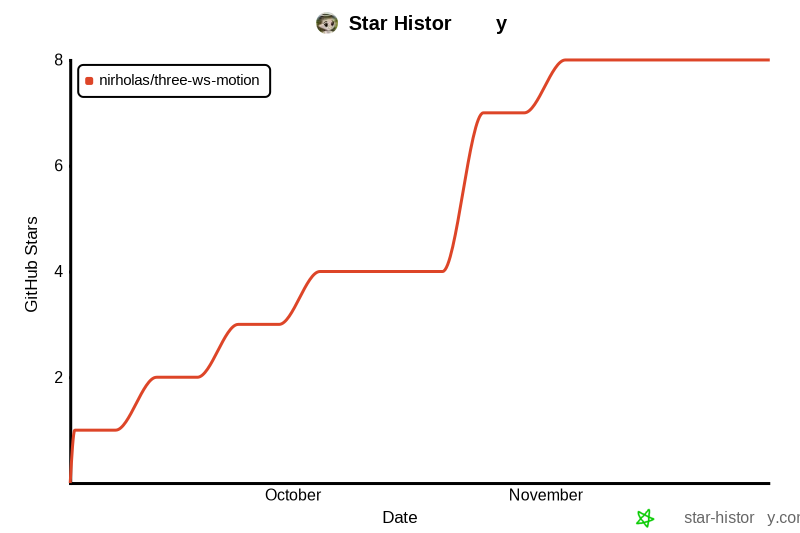
## Star history
[](https://www.star-history.com/#nirholas/three-ws-motion&Date)
<!-- /three.ws:growth -->
<!-- three.ws:ecosystem -->
## Part of three.ws
[three.ws](https://three.ws) is a platform for 3D AI agents with Solana wallets: avatars, a skill marketplace, x402 payments and more than seventy MCP servers. `@three-ws/motion` is one package from it.
- Documentation site: https://nirholas.github.io/three-ws-motion/
- npm: https://www.npmjs.com/package/@three-ws/motion
- Canonical source: https://github.com/nirholas/three.ws (this repository is a generated mirror of `packages/motion`)
- Agent-readable summary: [llms.txt](./llms.txt) and [AGENTS.md](./AGENTS.md)
- Issues and ideas: https://github.com/nirholas/three-ws-motion/issues
<!-- /three.ws:ecosystem -->