# @three-ws/render
<!-- three.ws:badges -->
[](https://github.com/nirholas/three-ws-render/stargazers) [](https://github.com/nirholas/three-ws-render/blob/HEAD/LICENSE) [](https://github.com/nirholas/three-ws-render/commits) [](https://github.com/nirholas/three-ws-render/pulls) [](https://github.com/nirholas/three-ws-render/blob/HEAD/AGENTS.md)
<!-- /three.ws:badges -->
Render rigged, animated 3D avatars to PNG, animated PNG, or truecolor terminal
output. **No GPU. No WebGL. No headless browser.** A pure-JavaScript software
rasterizer that runs anywhere Node runs: a serverless handler, a cron job, a
container with 512 MB of RAM, a CI step, your laptop.
```bash
npx @three-ws/render https://three.ws/avatars/default.glb --out avatar.png
```
This is the renderer behind every server-side avatar picture on three.ws. It
replaced a headless-chromium pipeline that cost a 300 MB browser launch and
3-15 seconds per cold render with an in-process call that takes a few hundred
milliseconds and fetches nothing.
## Why this exists
Rendering a 3D model on a server has meant one of two things: a GPU, or a
headless browser pretending to be one. Both are heavy, and both fail in the
places you most want a picture: a social-card handler with a 30 second budget,
a batch job over a hundred thousand models, a machine with no display stack at
all.
There is a third option nobody ships, because it is a lot of work: rasterize it
yourself. That is what this package is. It parses the glTF, blends the bone
matrices on the CPU, walks the triangles with a z-buffer, samples the textures
through real mip pyramids, and writes the pixels out. It is fast because it
only ever does the work a still frame actually needs.
## Install
```bash
npm install @three-ws/render
```
`three` is the only required dependency (used for glTF parsing, animation
sampling and matrix maths, never for rendering). `sharp` is optional and only
decodes JPEG textures; PNG textures decode in-process with `zlib`. Without
`sharp`, a JPEG-textured model renders with its material colours instead of its
maps, and everything else is identical.
## Use it
### A still
```js
import { renderAvatar, encodePng } from '@three-ws/render';
import { writeFile } from 'node:fs/promises';
const { frames } = await renderAvatar('https://three.ws/avatars/default.glb', {
width: 1200,
height: 630,
focus: 'full', // 'full' | 'bust' | 'head'
background: { inner: '#1b2440', outer: '#05060c' },
});
await writeFile('card.png', encodePng(frames[0]));
```
### An animation
```js
import { renderAvatar, encodeApng } from '@three-ws/render';
import { writeFile } from 'node:fs/promises';
const { frames } = await renderAvatar('avatar.glb', {
animation: 'walk.glb', // clips are retargeted onto this rig by bone name
clip: 'walk',
frames: 24,
fps: 20,
width: 320,
height: 320,
background: 'transparent',
});
await writeFile('walk.png', encodeApng(frames, { fps: 20 }));
```
Animated PNG rather than GIF on purpose: GIF would quantize the render to 256
colours and hard-edge the alpha, while APNG keeps the full 24-bit image and the
soft contact shadow, and every current browser plays it.
### A turntable, with no animation data at all
```js
const { frames } = await renderAvatar('prop.glb', { frames: 36, spin: 360 });
```
### In a terminal
```js
import { renderAvatar, toHalfBlocks, detectTerminal } from '@three-ws/render';
const term = detectTerminal();
const { frames } = await renderAvatar('avatar.glb', { width: 60, height: 60, preset: 'terminal' });
process.stdout.write(toHalfBlocks(frames[0], { truecolor: term.truecolor }));
```
Each terminal cell carries two vertical pixels (the upper half-block glyph,
foreground over background), so a 60-column render is 60x60 pixels rather than
60x30. On Kitty, Ghostty, WezTerm and iTerm2 the CLI sends the real PNG through
the terminal's own graphics protocol instead.
## CLI
```
three-ws-tty <model.glb | url> [options]
--out <file> write a PNG (animated PNG when --frames > 1)
--width <n> output width in pixels (default: fits the terminal)
--height <n> output height in pixels
--focus <mode> full | bust | head (default: full)
--preset <name> studio | terminal | daylight (default: terminal for tty)
--clip <name|idx> clip to play, from the model or --animation
--animation <file> GLB or clip JSON to retarget onto this rig
--frames <n> frame count (default: 1, or 36 with --spin)
--fps <n> frames per second (default: 20)
--spin <deg> turntable degrees across the loop
--yaw <deg> camera yaw (default: 26)
--pitch <deg> camera pitch (default: 6)
--bg <color> hex colour or 'transparent'
--loop keep animating in the terminal until interrupted
--blocks force half-blocks even where inline images work
--clips list the model's clips and exit
```
```bash
# A headshot, ready for an avatar field
three-ws-tty avatar.glb --focus head --width 512 --out headshot.png
# A looping wave, transparent, for a README
three-ws-tty avatar.glb --animation wave.glb --clip wave --frames 24 --bg transparent --out wave.png
# Look at a model you just downloaded, without opening anything
three-ws-tty ~/Downloads/model.glb --spin 360 --loop
```
## What it renders
- **Skinned humanoid avatars**, posed by real animation clips. Bone matrices are
blended per vertex on the CPU, and normals ride the same matrix, so a walking
avatar shades correctly instead of shimmering.
- **Meshopt-compressed and quantized glTF** (`EXT_meshopt_compression`,
`KHR_mesh_quantization`), which is what most three.ws avatars ship as.
- **Textures** through box-filtered mip pyramids with trilinear sampling and a
per-triangle level of detail, so a 1024px skin atlas on a 96px avatar reads as
skin rather than noise.
- **Transparency**: alpha-masked hair and eyelash cards, and a depth-tested
back-to-front blended pass for genuinely transparent materials.
- **A planar projected contact shadow**, blurred, so the model sits on a surface
instead of floating.
- **Supersampled edges**, resolved through an ACES tonemap into straight-alpha
RGBA.
## What it does not render
Stated plainly, because a renderer that lies about its coverage is worse than
one with gaps:
- **Draco-compressed geometry** (`KHR_draco_mesh_compression`) needs a decoder
this package does not ship. It throws with a message telling you to re-export
with `gltfpack -cc`.
- **KTX2 / Basis textures** are skipped; the material falls back to its base
colour factor, which is a real colour, not a placeholder.
- **Morph targets / blendshapes** are not evaluated. Skeletal animation is.
- **PBR is approximated.** Base colour, roughness and emissive drive a
Blinn-Phong studio rig with a rim light. There is no image-based lighting, no
metallic reflection and no ray tracing. It is built to make an avatar look
like itself in a card, not to be a path tracer.
## API
| Export | What it does |
|---|---|
| `renderAvatar(source, options)` | Load and render in one call. Returns `{ model, frames }`. |
| `AvatarModel.load(source, options)` | Load a GLB into a posable model. |
| `model.addClips(clips)` | Retarget clips onto this skeleton by bone name. |
| `model.play(nameOrIndex)` / `model.setTime(s)` | Pose the model. |
| `model.updateBounds()` | Re-measure the framing bounds after posing the skeleton yourself (bounds are otherwise taken once, in the bind pose). |
| `renderFrame(model, options)` | One RGBA frame. |
| `renderFrames(model, options)` | A frame list, with animation and turntable spin. |
| `frameCamera(bounds, options)` | The camera used for a given focus mode. |
| `encodePng(frame)` / `encodeApng(frames, { fps })` | Image bytes, no native dependency. |
| `toHalfBlocks(frame)` / `toKitty(png)` / `toITerm(png)` | Terminal output. |
| `detectTerminal()` | Columns, truecolor support, inline-image support. |
| `parseClipJson(json)` / `loadClipJson(url)` | three.js AnimationClip JSON. |
| `parseGlb` / `packGlb` / `stripImages` / `extractImages` | The GLB container layer. |
| `normalizeBoneName(name)` / `retargetClip(clip, skeleton)` | Rig-independent bone naming. |
| `PRESETS` / `FOCUS` | Named lighting rigs and framing modes. |
`source` is a URL, a file path, an `ArrayBuffer` or a typed array. Frames are
`{ width, height, data }` where `data` is straight-alpha RGBA, which is exactly
what `sharp`, `canvas`, `ImageData` and every encoder already expect.
### Options
| Option | Default | Meaning |
|---|---|---|
| `width` / `height` | `512` | Output size in pixels. |
| `supersample` | `2` | Render scale before the box-filtered resolve (1-4). |
| `preset` | `'studio'` | `studio`, `terminal` or `daylight`. |
| `focus` | `'full'` | `full`, `bust` or `head`. |
| `yaw` / `pitch` | `26` / `6` | Camera angles in degrees. |
| `fov` | `30` | Vertical field of view. |
| `background` | preset | `'transparent'`, `'#rrggbb'`, `[top, bottom]`, or `{ inner, outer }`. |
| `shadow` | preset | Contact-shadow strength, `0` to disable. |
| `frames` / `fps` | `1` / `24` | Animation length. |
| `spin` | `0` | Turntable degrees spread across the frames. |
| `clip` | `null` | Clip name or index to play. |
| `animation` | none | A second GLB whose clips are retargeted onto this rig. |
| `maxBytes` | 64 MB | Cap on the fetched model. |
| `maxTextureSize` | `1024` | Working texture resolution. |
## Rig support
Clips are bound by normalized bone name, so a Mixamo walk drives a Ready Player
Me body. `normalizeBoneName` collapses Mixamo (`mixamorig:LeftForeArm`), Ready
Player Me (`LeftForeArm`), VRM/VRoid (`J_Bip_L_UpperArm`), Blender
(`upper_arm.L`), and bare camelCase side suffixes (`shoulderL`) onto one key. A
clip whose rig shares fewer than four bones with the target is refused rather
than played as a scramble.
## Performance
Measured on one shared vCPU, rendering the default three.ws avatar (13k
triangles, six 512-1024px textures):
| Render | Time |
|---|---|
| Load and decode the model (once, then cached) | ~1.0 s |
| 512x512, 2x supersampled | ~520 ms |
| 1200x630 OG card, 2x supersampled | ~540 ms warm |
| 288x288, no supersampling | ~60 ms |
| 16-frame animation at 288x288 | ~910 ms |
Decoding dominates the first render, so hold the `AvatarModel` if you are
rendering the same avatar more than once.
## Where it runs on three.ws
- Every OG card and avatar thumbnail, through
[`api/_lib/render-cpu.js`](../../api/_lib/render-cpu.js). The dispatcher in
`api/_lib/render-glb.js` tries this lane first and keeps chromium as failover.
- [`GET /api/render/animate`](../../docs/api-reference.md), which turns any
public avatar into an animated PNG you can drop in a README.
## License
Apache-2.0
<!-- three.ws:growth -->
## Support the project
If three-ws-render saves you time, **[star it on GitHub](https://github.com/nirholas/three-ws-render)**. Stars are how other developers and AI agents find the repositories worth trusting, and they cost you one click.
Know someone who would use it? [Post on X](https://twitter.com/intent/tweet?text=three-ws-render%3A%20Render%20rigged%2C%20animated%203D%20avatars%20to%20PNG%2C%20GIF%20and%20truecolor%20terminal%20ANSI%20with%20no%20GPU%2C%20no%20WebGL&url=https%3A%2F%2Fgithub.com%2Fnirholas%2Fthree-ws-render) · [Share on Bluesky](https://bsky.app/intent/compose?text=three-ws-render%3A%20Render%20rigged%2C%20animated%203D%20avatars%20to%20PNG%2C%20GIF%20and%20truecolor%20terminal%20ANSI%20with%20no%20GPU%2C%20no%20WebGL%20https%3A%2F%2Fgithub.com%2Fnirholas%2Fthree-ws-render) · [Share on LinkedIn](https://www.linkedin.com/sharing/share-offsite/?url=https%3A%2F%2Fgithub.com%2Fnirholas%2Fthree-ws-render) · [Submit to Hacker News](https://news.ycombinator.com/submitlink?u=https%3A%2F%2Fgithub.com%2Fnirholas%2Fthree-ws-render&t=three-ws-render%3A%20Render%20rigged%2C%20animated%203D%20avatars%20to%20PNG%2C%20GIF%20and%20truecolor%20terminal%20ANSI%20with%20no%20GPU%2C%20no%20WebGL) · [Share on Reddit](https://www.reddit.com/submit?url=https%3A%2F%2Fgithub.com%2Fnirholas%2Fthree-ws-render&title=three-ws-render%3A%20Render%20rigged%2C%20animated%203D%20avatars%20to%20PNG%2C%20GIF%20and%20truecolor%20terminal%20ANSI%20with%20no%20GPU%2C%20no%20WebGL)
## Built for AI agents too
Coding agents and LLM tooling can read this repo directly: [AGENTS.md](./AGENTS.md), [llms.txt](./llms.txt), [llms-full.txt](./llms-full.txt). Point an agent at `https://github.com/nirholas/three-ws-render` and it has the context it needs.
## More from the same author
- [All repositories by nirholas](https://github.com/nirholas/nirholas#readme): the full catalog, grouped by topic
- [three.ws](https://three.ws): the platform for 3D AI agents with Solana wallets, a skill marketplace and x402 payments
- Questions or ideas: [open an issue](https://github.com/nirholas/three-ws-render/issues) or [start a discussion](https://github.com/nirholas/three-ws-render/discussions)
## Contributors
[](https://github.com/nirholas/three-ws-render/graphs/contributors)
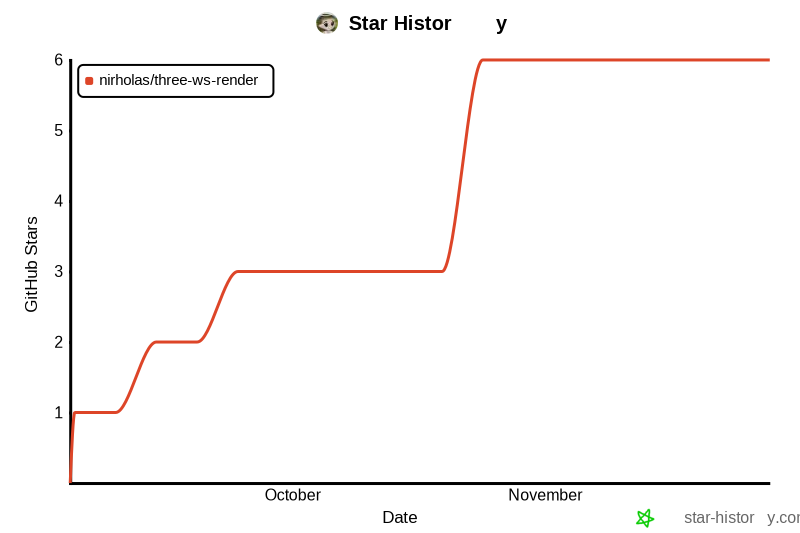
## Star history
[](https://www.star-history.com/#nirholas/three-ws-render&Date)
<!-- /three.ws:growth -->
<!-- three.ws:ecosystem -->
## Part of three.ws
[three.ws](https://three.ws) is a platform for 3D AI agents with Solana wallets: avatars, a skill marketplace, x402 payments and more than seventy MCP servers. `@three-ws/render` is one package from it.
- Documentation site: https://nirholas.github.io/three-ws-render/
- npm: https://www.npmjs.com/package/@three-ws/render
- Canonical source: https://github.com/nirholas/three.ws (this repository is a generated mirror of `packages/render`)
- Agent-readable summary: [llms.txt](./llms.txt) and [AGENTS.md](./AGENTS.md)
- Issues and ideas: https://github.com/nirholas/three-ws-render/issues
<!-- /three.ws:ecosystem -->