# pumpvault
<!-- three.ws:badges -->
[](https://github.com/nirholas/pumpvault/stargazers) [](https://github.com/nirholas/pumpvault/commits) [](https://github.com/nirholas/pumpvault/pulls) [](https://github.com/nirholas/pumpvault/blob/HEAD/AGENTS.md)
<!-- /three.ws:badges -->
Launch coins on [pump.fun](https://pump.fun), claim the creator fees they earn, and get funds out of a wallet whose key has leaked. Everything runs in the browser: keys are generated locally, encrypted with your passphrase, and never sent anywhere.
```
pumpvault
├─ Wallet generate a wallet, fund it by QR, see balances and fees
├─ Launch coin details, image, first buy, one atomic Jito bundle
├─ Claim every coin a wallet launched, and the fees waiting for it
└─ Rescue empty an exposed wallet before a sweeper bot does
```
There is no account, no backend database, and no custody. The included server does three jobs only: it serves the static files and forwards three requests the browser is not allowed to make directly.
---
## Why this exists
Three problems, one toolkit:
**Launching needs a funded wallet.** People without a Solana wallet cannot launch a coin at all. pumpvault generates one in the tab, shows a QR code, and tells you exactly how much SOL to send (roughly 0.05 covers a launch). Send funds the way you would top up a Bitrefill voucher, fill in the coin details, and launch.
**Creator fees go unclaimed.** Every pump.fun coin pays its creator a share of trading fees, held in an on-chain vault until somebody claims them. Most creators never look. Point pumpvault at any address to see what it is owed, then claim with the key.
**A leaked key is a race you lose.** Sweeper bots watch known-compromised addresses and take any SOL that lands, often in the same block. You cannot win that race by sending SOL for gas first, because the bot takes the gas. pumpvault's rescue uses a [Jito](https://jito.wtf) bundle: a separate clean wallet pays the fee and the tip, the exposed wallet only signs, and the collect and the transfer land in one atomic transaction. There is no slot in which a balance sits exposed.
## What atomic means here
Every money-moving action is a Jito bundle: a set of transactions that land in one block, in order, with nothing inserted between them, or do not land at all.
| Action | Bundle |
| --- | --- |
| Launch (one wallet) | `create` + tip, one transaction |
| Launch (separate creator) | Tx1: funder sends rent + first buy + tip to the creator. Tx2: creator runs `createV2`, pays its own fee and the tip, so the creator wallet needs no SOL beforehand |
| Claim | `sweep_creator_fee` for every curve and pool still holding fees, then `collectCoinCreatorFee`, optionally followed by a transfer to a safe wallet in the same transaction. Sweeps that do not fit ride in transactions just ahead of it in the same bundle |
| Rescue | collect fees, drain SOL, and move tokens, all in one bundle, funded by a clean wallet |
Every bundle tips exactly once, in its last transaction, so a tip is only ever paid alongside the work it pays for. A dropped bundle costs nothing but the network fee. A partial rescue never happens.
## Quick start
```bash
git clone https://github.com/nirholas/pumpvault
cd pumpvault
npm install
cp .env.example .env # optional: set RPC_URL to a paid endpoint
npm run dev # web app on :5173, proxy on :8787
```
For production:
```bash
npm run build && npm start # serves dist/ and the proxies on :8787
```
The public RPC works for trying it out. For real launches use a paid endpoint (Helius, Triton, QuickNode); public nodes rate-limit and drop transactions. Set it in `.env` as `RPC_URL` and it stays server-side.
## Using it
**Generate a wallet.** The Wallet page creates a keypair in the tab and asks for a vault passphrase. Back the private key up: it is encrypted in your browser's local storage and nowhere else, so a cleared browser with no backup means a lost wallet.
**Fund it.** Scan the QR with any Solana wallet, or copy the address. A launch needs about 0.03 SOL for rent and fees, plus whatever you want as your first buy.
**Launch.** Fill in the name, ticker, image, and description on the Launch page. The cost panel itemises rent, first buy, tip, and fees before you commit, and the confirmation dialog shows exactly what leaves your wallet. Nothing is signed until you approve it.
**Claim.** The Claim page lists every coin an address launched (from the pump.fun API and an on-chain scan, merged) with the fees waiting. The total is itemised: what is already in the creator vault, and what is still waiting on bonding curves and in PumpSwap pools (see below). Claim into the same wallet, or send the claim straight to a different one, which is what you want if the key has ever been exposed.
**Rescue.** Pick the compromised wallet, a clean wallet to pay, and a safe destination. pumpvault scans for SOL, unclaimed fees, and token balances, then moves everything in one bundle.
## Fee routing, and why a coin sometimes cannot be claimed
pump.fun sends creator fees to one of four places, and pumpvault labels each coin with which:
- **creator**: the normal case. The creator wallet claims with `collect`.
- **fee sharing**: the coin has a sharing config splitting fees among several shareholders. Anyone can run `distribute`, which pays every shareholder their share; the Claim page offers that instead of a claim button.
- **cashback**: fees go back to traders. There is no creator vault, and nothing to claim. pump.fun no longer creates cashback coins (the program rejects them), so pumpvault only recognises existing ones and cannot launch new ones.
- **holder rewards**: protocol creator fees accrue to token holders. The creator cannot collect or distribute these fees.
## Fees waiting on the curve and in the pool
Since the October 2026 Pump and PumpSwap upgrade, the new trade instructions (Pump `buy_v3` / `sell_v3`, PumpSwap `buy_v2` / `sell_v2`, multi-hop swaps) no longer pay the creator vault on every trade. The creator's share waits on the coin itself: in the bonding curve's `creator_fee` field before graduation, and in the PumpSwap pool's `creator_fees` field after. A permissionless `sweep_creator_fee` instruction moves it into the creator vault, and only then can `collect` or `distribute` pay it out.
pumpvault handles both halves:
- **Balances include waiting fees, labelled.** Wallet, Claim, Rescue and the CLI show one total, split into *in your vault*, *waiting on bonding curves* and *waiting in PumpSwap pools*, so a creator whose fees are all waiting is not told there is nothing to claim. Each coin on the Claim page shows its own waiting amount.
- **Every claim sweeps first.** Claim and Rescue put a `sweep_creator_fee` for each curve and pool with a non-zero bucket in front of the collect, largest first, in the same transaction while it fits and in sweep-only transactions ahead of it in the same atomic bundle otherwise. A bucket that does not fit in the bundle's five transactions is left for the next claim and reported. Distribute on a fee-sharing coin sweeps the curve and pool the same way before paying shareholders.
Waiting fees are counted and swept for SOL-paired coins. A coin paired with another quote mint (USDC, or another pump coin) keeps its fees in that mint, which the SOL claim does not collect.
## Command line
The same flows, for servers and scripts:
```bash
npx pumpvault balance --wallet <pubkey>
npx pumpvault coins --creator <pubkey>
npx pumpvault fees --creator <pubkey>
CREATOR_SECRET=<base58> npx pumpvault launch \
--name "Nyan Cat" --symbol NYAN --image ./logo.png --dev-buy 0.02
CREATOR_SECRET=<base58> npx pumpvault claim --to <safe-wallet>
VICTIM_SECRET=<base58> FUNDER_SECRET=<base58> \
npx pumpvault rescue --to <safe-wallet> --tokens
```
Keys are read from environment variables or keypair files, never from arguments, because other users on a machine can read a process list. Anything that spends prints a summary and waits for confirmation unless you pass `--yes`. Full help: `npx pumpvault --help`.
## Library
Every piece is importable on its own, with no UI attached:
```js
import { Connection, Keypair } from '@solana/web3.js';
import {
getCreatorFeeBreakdown, buildCollectInstructions, fetchPumpLookupTables,
planCollect, executePlan, resolveTipAccount,
} from 'pumpvault';
const connection = new Connection(process.env.RPC_URL, 'confirmed');
const creator = Keypair.fromSecretKey(/* your key */);
// In the vault now, plus what still waits on curves and in pools.
const fees = await getCreatorFeeBreakdown(connection, creator.publicKey);
if (fees.totalLamports > 0) {
const [claim, lookupTables, tipAccount, balance] = await Promise.all([
buildCollectInstructions(connection, creator.publicKey, creator.publicKey),
fetchPumpLookupTables(connection),
resolveTipAccount(),
connection.getBalance(creator.publicKey),
]);
// A plan is inert: it describes the transactions and summarises them for a
// confirmation screen. Nothing is signed or sent until executePlan runs.
// `claim` carries the collect, the sweeps for waiting fees, and the amounts.
const plan = planCollect({
...claim, lookupTables,
funder: creator, creator, destination: 'YourSafeWallet…',
creatorBalanceLamports: balance, tipLamports: 1_000_000, tipAccount,
});
console.log(plan.summary);
const { bundleId, signatures } = await executePlan(connection, plan);
}
```
Entry points: `pumpvault` (everything), `pumpvault/keys`, `/vault`, `/jito`, `/pump`, `/fees`, `/atomic`. See [docs/library.md](docs/library.md).
## How keys are handled
- Generated in the browser with `crypto.getRandomValues`, via `@solana/web3.js`.
- Encrypted with AES-256-GCM under a key derived from your passphrase by PBKDF2-SHA256 (600,000 iterations), each blob with its own salt and IV.
- Stored encrypted in `localStorage`. The plaintext passphrase is cached in `sessionStorage` so moving between pages does not re-prompt; that cache is per-tab, expires after 15 minutes of inactivity, and is cleared by Lock.
- Never transmitted. Transactions are signed locally and posted straight to Jito's block engine from your browser.
- The server never receives a key, and there is nothing on it to breach.
The honest tradeoffs are in [docs/security.md](docs/security.md), including what the session cache means and what a compromised browser can still do.
## The server
`server/index.mjs` is deliberately small:
| Route | Why it exists |
| --- | --- |
| `POST /api/rpc` | Keeps a paid RPC key server-side rather than shipping it to every visitor |
| `GET /api/pump/*` | pump.fun's API returns 403 to browser origins |
| `POST /api/ipfs` | pump.fun's IPFS upload endpoint sends no CORS headers |
It holds no state and stores nothing. Point it at your own RPC and it is the whole backend.
## Development
```bash
npm run dev # vite on :5173 with the proxy on :8787
npm run lint # eslint
npm test # vitest
npm run build # static site into dist/
```
Tests cover the parts where a mistake costs money or leaks a key: secret-key parsing, vault encryption and key wiping, every transfer amount and tip placement the plan builders compute, bundle submission and confirmation, and the proxy allowlists. None of them touch the network.
## Credits
- Bundle patterns from [nirholas/atomic](https://github.com/nirholas/atomic).
- Interface built on the design language of [nirholas/solana-launchpad-ui](https://github.com/nirholas/solana-launchpad-ui).
- On-chain work through [`@pump-fun/pump-sdk`](https://www.npmjs.com/package/@pump-fun/pump-sdk) 4.0 and [`@pump-fun/pump-swap-sdk`](https://www.npmjs.com/package/@pump-fun/pump-swap-sdk) 2.1, which cover the October 2026 Pump and PumpSwap upgrade. Account reads go through the SDK decoders, which accept both the shorter pre-upgrade layouts and the longer current ones, and read the pool's `virtual_quote_reserves` as the signed value it is.
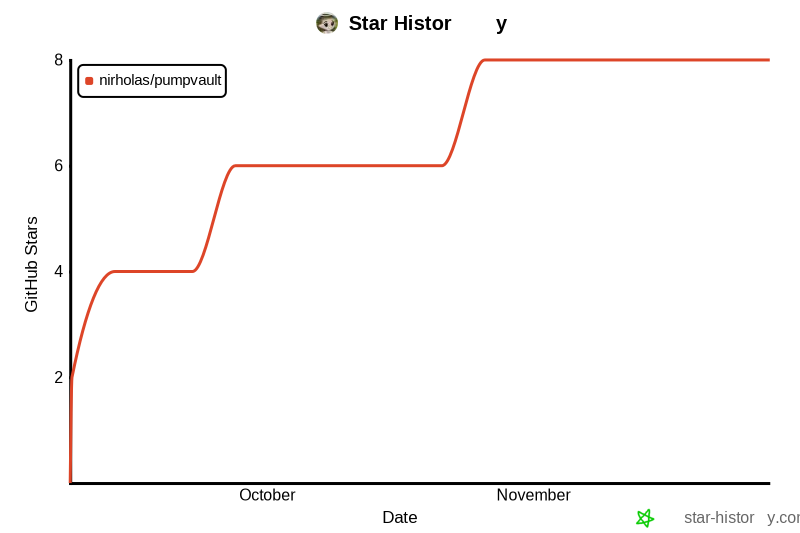
## Star History
[](https://www.star-history.com/#nirholas/pumpvault&Date)
<!-- three.ws:growth -->
## Support the project
If pumpvault saves you time, **[star it on GitHub](https://github.com/nirholas/pumpvault)**. Stars are how other developers and AI agents find the repositories worth trusting, and they cost you one click.
Know someone who would use it? [Post on X](https://twitter.com/intent/tweet?text=pumpvault%3A%20Launch%20coins%20on%20pump.fun%2C%20claim%20the%20creator%20fees%20they%20earn%2C%20and%20get%20funds%20out%20of%20a%20wallet%20whose%20key&url=https%3A%2F%2Fgithub.com%2Fnirholas%2Fpumpvault) · [Share on Bluesky](https://bsky.app/intent/compose?text=pumpvault%3A%20Launch%20coins%20on%20pump.fun%2C%20claim%20the%20creator%20fees%20they%20earn%2C%20and%20get%20funds%20out%20of%20a%20wallet%20whose%20key%20https%3A%2F%2Fgithub.com%2Fnirholas%2Fpumpvault) · [Share on LinkedIn](https://www.linkedin.com/sharing/share-offsite/?url=https%3A%2F%2Fgithub.com%2Fnirholas%2Fpumpvault) · [Submit to Hacker News](https://news.ycombinator.com/submitlink?u=https%3A%2F%2Fgithub.com%2Fnirholas%2Fpumpvault&t=pumpvault%3A%20Launch%20coins%20on%20pump.fun%2C%20claim%20the%20creator%20fees%20they%20earn%2C%20and%20get%20funds%20out%20of%20a%20wallet%20whose%20key) · [Share on Reddit](https://www.reddit.com/submit?url=https%3A%2F%2Fgithub.com%2Fnirholas%2Fpumpvault&title=pumpvault%3A%20Launch%20coins%20on%20pump.fun%2C%20claim%20the%20creator%20fees%20they%20earn%2C%20and%20get%20funds%20out%20of%20a%20wallet%20whose%20key)
## Built for AI agents too
Coding agents and LLM tooling can read this repo directly: [AGENTS.md](./AGENTS.md), [llms.txt](./llms.txt), [llms-full.txt](./llms-full.txt). Point an agent at `https://github.com/nirholas/pumpvault` and it has the context it needs.
## More from the same author
- [All repositories by nirholas](https://github.com/nirholas/nirholas#readme): the full catalog, grouped by topic
- [three.ws](https://three.ws): the platform for 3D AI agents with Solana wallets, a skill marketplace and x402 payments
- Questions or ideas: [open an issue](https://github.com/nirholas/pumpvault/issues) or [start a discussion](https://github.com/nirholas/pumpvault/discussions)
## Contributors
[](https://github.com/nirholas/pumpvault/graphs/contributors)
<!-- /three.ws:growth -->
<!-- nirholas:watermark -->
---
<p align="center">
Built by <a href="https://github.com/nirholas"><b>nirholas</b></a> · <a href="https://x.com/nichxbt">@nichxbt</a> · <a href="https://github.com/nirholas">github.com/nirholas</a>
</p>
<!-- /nirholas:watermark -->