| name | iblai-vibe-agent-chat |
| description | Add the in-process Chat SDK component (full agent surface — message stream, canvas, file attach, voice, prompts) to a Next.js app |
| globs | null |
| alwaysApply | false |
/iblai-vibe-agent-chat
Add the full ibl.ai agent chat surface — message stream, conversation
starters, canvas, file attach, voice input, voice call, screen sharing,
prompt gallery — to your Next.js app. Uses the Chat React component
from @iblai/iblai-js/web-containers/next, which renders in-process
(not in an iframe) and shares the host app's Redux store, providers, and
auth session.
Template (legacy <mentor-ai> widget): a full-screen <mentor-ai>
web-component ChatWidget (distinct from the in-process Chat component
this skill documents) — bundled as
assets/chat-widget.tsx.j2 +
assets/iblai-web-mentor.d.ts. See
/iblai-vibe-scaffold for the {{ }} contract.
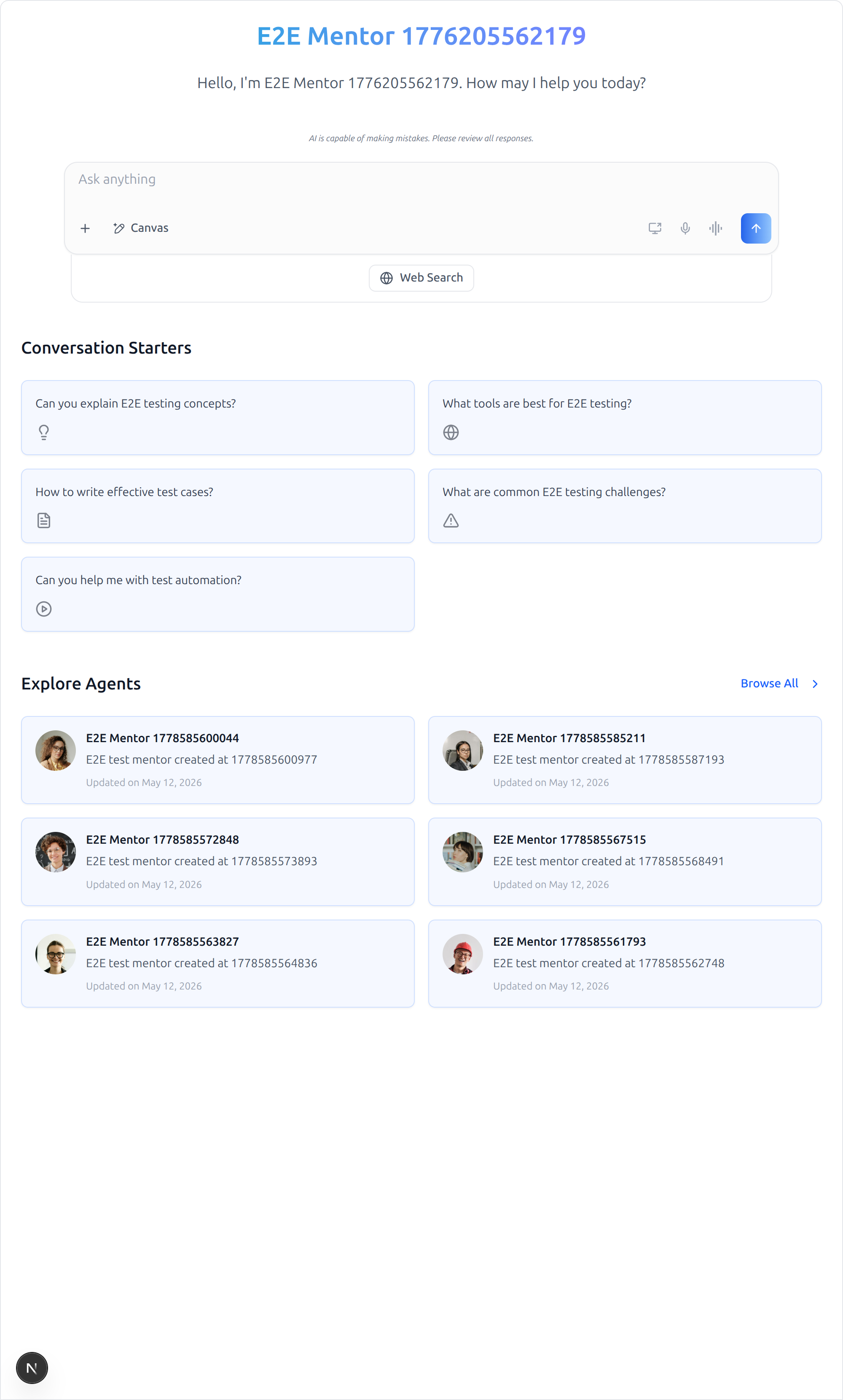
What you get: the SDK's Chat component wired directly into your
app (in-process, not an iframe). Full feature surface, intercept
actions, shared auth/store with the rest of your app, themeable with
your Tailwind config.
Do NOT add custom styles, colors, or CSS overrides to the SDK Chat
component. It ships with its own styling. Keep the component as-is.
Do NOT implement dark mode unless the user explicitly asks for it.
This is a revised skill. It folds in everything learned from a
real brownfield integration (Next.js App Router, React 19, RTK, pnpm,
sub-path basePath). Greenfield apps can mostly follow the happy
path; brownfield apps must read the Brownfield and Known
issues notes — most of the integration cost lives there, not in the
happy path.
Common setup (brand, conventions, env files, verification): see
docs/skill-setup.md.
Prerequisites
-
Auth must be set up first (/iblai-vibe-auth) — the Chat component reads
the axd token, username, and tenants from the providers tree.
-
A working store, providers, and SSO callback route — i.e. an app that
already passes /iblai-vibe-auth verification.
-
An agent/mentor ID (a UUID) — get one at https://mentorai.iblai.app.
-
Minimum SDK versions. The Chat component and its required hooks
are only present in recent SDKs. Older-but-recent installs silently
lack them. Require at least:
| package | min version |
|---|
@iblai/iblai-js | ^1.10.3 |
@iblai/web-containers | 1.6.14 |
@iblai/web-utils | 1.6.9 |
@iblai/data-layer | 1.5.7 |
-
Pre-flight export check (do this before writing any code):
grep -qE "declare function Chat\b|type ChatConfig" \
  node_modules/@iblai/web-containers/dist/next/index.d.ts \
  && echo "Chat present" \
  || echo "MISSING — upgrade the SDK packages (see Step 3)"
@iblai/iblai-js/web-containers/next re-exports @iblai/web-containers/next;
the component physically lives in @iblai/web-containers. If the
check fails, the rest of this skill cannot work — upgrade first.
Caveat: the SDK .d.ts is incomplete and sometimes misleading.
Several runtime props/args (e.g. getChatHistory's userId path
param) are absent from the type defs, and some documented slot props
are typed but not implemented. When something doesn't match, verify
against node_modules/@iblai/web-containers/dist/next/index.esm.js
(the actual bundle), not just the types.
What Gets Wired
| File | Change |
|---|
package.json | Adds SDK packages + peers (Step 3) |
providers/index.tsx | Wraps tree in <ServiceWorkerProvider>; skip={isSsoLoginRoute} on Auth/Tenant providers (Step 4) |
public/sw.js | The SDK offline service worker — required by ServiceWorkerProvider (Step 4) |
next.config.* | Service-Worker-Allowed header for sub-path mounts; reactStrictMode:false (Step 4, Known issues) |
store/index.ts | Registers chat, chatInput, chatSliceShared, files, rbac, subscription, topBanner reducers (Step 5) |
app/agents/[mentorId]/chat-new/page.tsx | New route rendering <Chat> with resume/new-chat handling (Step 6) |
components/radix-pointer-events-guard.tsx | Host recovery for the SDK prompt-gallery teardown bug (Known issues) |
Step 1: Check Environment
Confirm .env.local has the env vars the SDK reads at runtime:
NEXT_PUBLIC_BASE_WS_URL=wss://asgi.data.iblai.org
NEXT_PUBLIC_AUTH_URL=https://auth.iblai.org
NEXT_PUBLIC_DM_URL=https://api.iblai.org/dm
NEXT_PUBLIC_LMS_URL=https://api.iblai.org/lms
NEXT_PUBLIC_AXD_URL=https://api.iblai.org/dm
NEXT_PUBLIC_AGENT_URL=http://localhost:3000
NEXT_PUBLIC_MAIN_TENANT_KEY=<your-platform-key>
NEXT_PUBLIC_SUPPORT_EMAIL=support@ibl.ai
Note: some host config helpers don't expose supportEmail(). If
yours doesn't, read process.env.NEXT_PUBLIC_SUPPORT_EMAIL directly in
ChatConfig (Step 6) — don't assume the helper has every field.
Step 2: Get the Agent ID
Ask the user for their agent/mentor UUID. Write it directly to
.env.local using the Edit tool — do NOT echo it back in shell
commands:
NEXT_PUBLIC_DEFAULT_AGENT_ID=<the-uuid>
If the user doesn't have one, direct them to https://mentorai.iblai.app
to create an agent.
Step 3: Install Dependencies
pnpm add @iblai/data-layer @iblai/web-containers @iblai/web-utils \
         @iblai/agent-ai \
         react-paginate livekit-client \
         @livekit/components-react @livekit/components-styles \
         @tauri-apps/plugin-os @tauri-apps/api
Why each one:
| Package | Used by |
|---|
@iblai/data-layer, @iblai/web-containers, @iblai/web-utils | Hoist SDK packages to top-level node_modules so the bundler resolves them from the host |
@iblai/agent-ai | Voice/agent web component — dynamically imported by <Chat> (import('@iblai/agent-ai')). Easy to miss; its absence is a hard build error |
react-paginate | Peer of @iblai/web-containers (agent search pagination) |
livekit-client, @livekit/components-react, @livekit/components-styles | Voice call / screen-sharing |
@tauri-apps/plugin-os, @tauri-apps/api | OS detection (Tauri desktop wrapper) |
All of these are build-time-required, even the runtime-guarded
ones. <Chat> statically/dynamically imports them; a missing
package is a hard Module not found from Turbopack/Webpack, not a
soft runtime fallback. Don't defer any of them "until needed".
If on a fresh upgrade you hit Module not found: Can't resolve '@iblai/...' for a name you did install, the export may have moved
between subpaths — e.g. AgentSearchResult moved from
@iblai/iblai-js/web-containers to @iblai/iblai-js/web-containers/next.
Expect to fix a few import paths after an SDK bump; the
/web-containers vs /web-containers/next split is real (the chat
component lives under /next).
Step 4: Wire the Providers + Service Worker
The Chat component uses useAuthContext, useTenantContext,
useEmbedMode, useServiceWorker, and several Redux hooks. The host
needs all of these.
4a. Providers
In providers/index.tsx:
- Import
ServiceWorkerProvider from @iblai/iblai-js/web-utils.
- Wrap the existing
<AuthProvider> tree in <ServiceWorkerProvider>.
- Pass
skip={isSsoLoginRoute} to both <AuthProvider> and
<TenantProvider> so the /sso-login-complete callback page doesn't
crash on missing context.
- Pass
basePath if the app is mounted under a sub-path (e.g.
NEXT_PUBLIC_BASE_PATH=/hq):
import {
  AuthProvider,
  TenantProvider,
  MentorProvider,
  ServiceWorkerProvider,
} from "@iblai/iblai-js/web-utils";

return (
  <ServiceWorkerProvider basePath={config.basePath() /* "" or "/hq" */}>
    <AuthProvider /* …, */ skip={isSsoLoginRoute}>
      <TenantProvider /* …, */ skip={isSsoLoginRoute}>
        <MentorProvider {...mentorProps}>{children}</MentorProvider>
      </TenantProvider>
    </AuthProvider>
  </ServiceWorkerProvider>
);
4b. Ship the service worker (required)
ServiceWorkerProvider calls
navigator.serviceWorker.register(${basePath}/sw.js, { scope: basePath || "/" }).
The host must provide public/sw.js — the SDK does not ship a
copyable one. Without it, registration 404s (non-fatal but noisy, and
offline is disabled). Use the SDK's standard offline worker (generic;
cache-in-background, serve-from-cache only when Tauri+offline). A known
working sw.js is bundled with this skill — copy it to public/sw.js.
4c. Service-Worker-Allowed header (sub-path mounts only)
If the app is under a basePath, the script lives at /hq/sw.js,
whose default max scope is /hq/, but the provider registers with
scope: "/hq" → SecurityError: scope ('/hq') is not under the max scope allowed ('/hq/'). Fix in next.config:
async headers() {
return [
{
source: '/sw.js',
headers: [{ key: 'Service-Worker-Allowed', value: basePath || '/' }],
},
]
}
(No-op safe when there's no basePath: header value /.)
Step 5: Register Store Reducers
In store/index.ts, register these reducers. The SDK's selectors
hard-code these exact keys (state.chat, state.rbac, …) — they are
non-negotiable:
import {
coreApiSlice, mentorReducer, mentorMiddleware,
} from "@iblai/iblai-js/data-layer";
import {
hostChatReducer,
chatInputSliceReducer,
chatSliceReducerShared,
filesReducer,
rbacReducer,
subscriptionReducer,
topBannerReducer,
} from "@iblai/iblai-js/web-utils";
reducer: {
chat: hostChatReducer,
chatInput: chatInputSliceReducer,
chatSliceShared: chatSliceReducerShared,
files: filesReducer,
rbac: rbacReducer,
subscription: subscriptionReducer,
topBanner: topBannerReducer,
[coreApiSlice.reducerPath]: coreApiSlice.reducer,
...mentorReducer,
}
Brownfield: store-key collisions. A mature app very likely already
has its own chat / files (or rbac/subscription/…) slices with
different shapes. The SDK's keys are fixed, so rename the host's
slices, not the SDK's. Find collisions first:
grep -rn "state\.\(chat\|files\|rbac\|subscription\|topBanner\|chatInput\)\b" \
  --include="*.ts" --include="*.tsx" app components lib hooks
Rename each host slice (e.g. chat → v0Chat) and migrate every
selector that reads it (slice name and action creators are
key-agnostic — only useSelector(s => s.<key>) accesses change).
mentorReducer is RTK Query API slices only; it does not shadow
plain feature slices like chat/files.
The slice keys matter — don't rename them. mentorMiddleware is
still concatenated as before.
Step 6: Create the Route
Create app/agents/[mentorId]/chat-new/page.tsx. This version handles
session resume, new-chat, the useSearchParams Suspense requirement,
and the mounting discipline (see notes after the code):
"use client";
export const dynamic = "force-dynamic";
import { Suspense, useEffect, useState } from "react";
import { useParams, useRouter, useSearchParams } from "next/navigation";
import { Chat, type ChatConfig } from "@iblai/iblai-js/web-containers/next";
import {
useUsername, useAxdToken, useUserTenants, useVisitingTenant,
useIsAdmin, useCachedSessionId,
} from "@iblai/iblai-js/web-utils";
import { redirectToAuthSpa } from "@/lib/utils";
import { config } from "@/lib/config";
export default function AgentChatPageWrapper() {
return (
<Suspense fallback={null}>
<AgentChatPage />
</Suspense>
);
}
function AgentChatPage() {
const { mentorId } = useParams<{ mentorId: string }>();
const router = useRouter();
const searchParams = useSearchParams();
const restoreSessionId = searchParams.get("session") ?? undefined;
const newParam = searchParams.get("new") ?? undefined;
const [cachedSessionId, saveCachedSessionId] = useCachedSessionId();
const [seededFor, setSeededFor] = useState<string | undefined>(
restoreSessionId || newParam ? undefined : "none",
);
useEffect(() => {
if (!mentorId) { setSeededFor("none"); return; }
const map = { ...((cachedSessionId ?? {}) as Record<string, string>) };
if (restoreSessionId) {
if (map[mentorId] !== restoreSessionId) {
saveCachedSessionId({ ...map, [mentorId]: restoreSessionId });
}
setSeededFor(restoreSessionId);
} else if (newParam) {
if (map[mentorId]) { delete map[mentorId]; saveCachedSessionId(map); }
setSeededFor(`new:${newParam}`);
} else {
setSeededFor("none");
}
}, [restoreSessionId, newParam, mentorId]);
const sessionReady = restoreSessionId
? seededFor === restoreSessionId
: newParam
? seededFor === `new:${newParam}`
: true;
const [tenantKey, setTenantKey] = useState("");
useEffect(() => {
const appTenant = localStorage.getItem("app_tenant");
const tenant = localStorage.getItem("tenant");
let currentTenant = "";
try {
currentTenant =
JSON.parse(localStorage.getItem("current_tenant") ?? "{}")?.key ?? "";
} catch {}
setTenantKey(appTenant || currentTenant || tenant || config.mainTenantKey());
}, []);
const username = useUsername();
const axdToken = useAxdToken();
const { userTenants } = useUserTenants();
const { visitingTenant } = useVisitingTenant();
const isAdmin = useIsAdmin();
const chatConfig: ChatConfig = {
baseWsUrl: () => config.baseWsUrl(),
supportEmail: () =>
process.env.NEXT_PUBLIC_SUPPORT_EMAIL ?? "support@ibl.ai",
authUrl: () => config.authUrl(),
mainTenantKey: config.mainTenantKey(),
navigateToAdminBilling: () =>
router.push(`/agents/${mentorId}/settings?tab=billing`),
navigateToExplore: () => router.push("/agents"),
navigateToMentor: (id) => router.push(`/agents/${id}`),
};
if (!tenantKey || !sessionReady) return null;
return (
<div className="flex h-screen w-full flex-col">
<Chat
// Key on mentor+session+new so an intentional switch remounts
// <Chat> and the SDK re-reads the cached session. Do NOT remount
// it any other way (see "Mounting discipline").
key={`${mentorId}:${restoreSessionId ?? ""}:${newParam ?? ""}`}
isPreviewMode={false}
mentorId={mentorId}
tenantKey={tenantKey}
config={chatConfig}
// Wrap so the callback is `=> void` (host helpers are often
// async / extra-arg; SDK type wants `(…) => void`).
redirectToAuthSpa={(to, key, logout) =>
void redirectToAuthSpa(to, key, logout)
}
username={username ?? null}
userTenants={userTenants ?? []}
visitingTenant={visitingTenant}
axdToken={axdToken ?? ""}
userIsStudent={!isAdmin}
/>
</div>
);
}
Why each piece:
| Item | Why |
|---|
"use client" + dynamic = "force-dynamic" | Chat is client-only; prevent static pre-render |
<Suspense> wrapper | useSearchParams() requires a Suspense boundary in App Router |
useCachedSessionId seeding + render gate | only way to resume / start-new (no sessionId prop, no URL handling — see "Resuming / starting sessions") |
key={mentor:session:new} | the ONLY safe remount; switching session needs it |
void redirectToAuthSpa(...) wrapper | SDK type is (…) => void; host helper is often async |
env fallback for supportEmail | host config may not expose it |
Mounting discipline
The SDK reads session/voice state once at <Chat> mount and has an
isMounted defect (see Known issues), so an unintended remount is
destructive (loses session, wedges voice). Rules:
- Never conditionally swap subtrees around
<Chat>
(isMobile ? <A/> : <B/> with <Chat> in both → remount on
breakpoint resolve). Use one stable tree and change layout via
props (e.g. ResizablePanelGroup direction), not subtree swaps.
- The only legitimate remount is an intentional session/new-chat
key change (Step 6).
const el = (<Chat .../>) reused in the same JSX position is fine
(React reconciles — not a remount).
Resuming / starting sessions
<Chat> has no sessionId prop and does not read a session
URL param. Sessions live in localStorage via useCachedSessionId()
→ { [mentorId]: sessionId }, read once at mount.
- Resume (e.g. host history link →
?session=<id>): seed
cachedSessionId[mentorId] = id before mount, gate render, key
<Chat> on the id (Step 6).
- New chat:
delete cachedSessionId[mentorId] + remount via a
changing key nonce (?new=<ts>). Just navigating does not start a
new chat — the SDK resumes the persisted session.
- There is no host-readable "conversation loaded" signal.
isLoadingChats is internal to useAdvancedChat; chatSliceShared
is not reset between sessions, so selectSessionId /
selectNumberOfActiveChatMessages read stale on first render.
For a "loading" overlay during resume, use a guaranteed-minimum +
hard-capped timer, not a slice-derived condition.
Host history list (getChatHistory)
Endpoint: /api/ai-analytics/orgs/{org}/users/{user_id}/chat-history/.
userId → URL path {user_id} (required to form the URL; absent
from the d.ts arg type but real).filterUserId → filter_user_id query — what actually restricts
results. For an org admin the path alone returns org-wide; pass
both userId and filterUserId (= signed-in username) to scope
to the current user.
Props
| Prop | Type | Required | Description |
|---|
mentorId | string | yes | Agent/mentor UUID |
tenantKey | string | yes | Platform/tenant key |
config | ChatConfig | yes | URLs + navigation callbacks |
redirectToAuthSpa | (redirectTo?, platformKey?, logout?) => void | yes | Host-owned auth redirect (wrap async helpers to => void) |
username | string | null | yes | Current user; null for anonymous |
userTenants | Tenant[] | yes | From useUserTenants |
axdToken | string | yes | AXD auth token |
userIsStudent | boolean | yes | RBAC role hint |
visitingTenant | Tenant | undefined | no | Viewing another tenant's agent |
isPreviewMode | boolean | yes | true for admin preview |
mode | "default" | "advanced" | no | "advanced" enables builder UI |
isPublicRoute | boolean | no | Unauthenticated share links |
slot overrides (canvasView, disclaimerModal, advancedChatHeader, advancedChatBuilder, liveKitChat, liveKitScreenSharing, welcomeChat, promptGalleryModal) | React.ComponentType<…> | no | Availability is SDK-version-dependent. As of web-containers@1.6.14 these are NOT implemented — Chat does not destructure them and they're absent from index.d.ts. Verify in dist/next/index.d.ts before relying on any of them; do not assume a slot override will take effect. |
onSubscriptionGate, on402Error, canPerformAction, renderDocumentSidebar, projectId, onExploreClick, onMentorClick, projectLandingPage | mixed | no | As available in your SDK version |
ChatConfig
| Field | Type | Description |
|---|
baseWsUrl | () => string | WebSocket origin |
supportEmail | () => string | Footer / error-toast email (env fallback if host config lacks it) |
authUrl | () => string | Auth SPA origin |
mainTenantKey | string | Default tenant key |
navigateToAdminBilling | () => void | Open the billing tab |
navigateToExplore | () => void | "Browse All" agents link |
navigateToMentor | (id: string) => void | Open an individual agent |
appSyncBanner? | { badge, text, link, linkText } | null | Optional sync banner |
Known issues & host workarounds
These are SDK-side defects/limitations confirmed against
web-containers@1.6.14 / web-utils@1.6.9. Fix upstream if you can;
otherwise apply the host workaround.
Voice "Processing…" hangs forever (React StrictMode / remounts)
useVoiceChat's isMounted ref is only ever reset to false (effect
cleanup), never back to true on setup. React StrictMode (Next default)
double-invokes effects in dev (mount→cleanup→remount) → the ref stays
false → audio-to-text resolves but the isMounted-guarded
setProcessing(false) is skipped → stuck "Processing…". Any <Chat>
remount reproduces it.
- Workaround:
reactStrictMode: false in next.config (dev-only
behavior; prod runs effects once) and follow "Mounting
discipline" so <Chat> doesn't remount.
- Real fix (upstream): add
isMounted.current = true; to the
effect setup in useVoiceChat.
Prompt-gallery dialog wedges the whole app
The bundled PromptGalleryModal is a Radix dialog whose teardown leaves
document.body { pointer-events: none } and sibling
inert/aria-hidden after close → the entire app becomes unclickable.
The promptGalleryModal slot override does not exist in this SDK
(see Props), so it can't be replaced via API.
- Workaround: mount a global recovery component at the app root that
clears the stuck lock only when no Radix dialog is open (no-op
while a modal is legitimately open):
"use client";
import { useEffect } from "react";
const OPEN = '[role="dialog"][data-state="open"],[role="alertdialog"][data-state="open"],[data-radix-popper-content-wrapper]';
function recover() {
  if (document.querySelector(OPEN)) return;
  if (document.body.style.pointerEvents === "none") document.body.style.pointerEvents = "";
  for (const el of Array.from(document.body.children)) {
    if (el.hasAttribute("inert")) el.removeAttribute("inert");
    if (el.getAttribute("aria-hidden") === "true") el.removeAttribute("aria-hidden");
  }
}
export function RadixPointerEventsGuard() {
  useEffect(() => {
    recover();
    const mo = new MutationObserver(recover);
    mo.observe(document.body, { attributes: true, attributeFilter: ["style","inert","aria-hidden"], childList: true, subtree: true });
    const onDown = () => recover();
    document.addEventListener("pointerdown", onDown, true);
    return () => { mo.disconnect(); document.removeEventListener("pointerdown", onDown, true); };
  }, []);
  return null;
}
Mount it once next to your store/providers. This is recovery, not a
root-cause fix — the gallery still tears down wrong, but the app stays
usable.
- Real fix (upstream): correct the dialog teardown, or actually
implement the
promptGalleryModal slot so hosts can supply a
cleanly-unmounting modal.
Step 7: Verify
pnpm build — must pass with zero errors. (Watch for
Module not found on the Step 3 peers, esp. @iblai/agent-ai.)pnpm test — host unit suite still green (esp. any slices you
renamed in the Brownfield step).pnpm dev — open the route, sign in, and walk:
- agent name + greeting, "Ask anything" textarea, action buttons
(attach / canvas / screen share / voice input / voice call / send),
conversation starters;
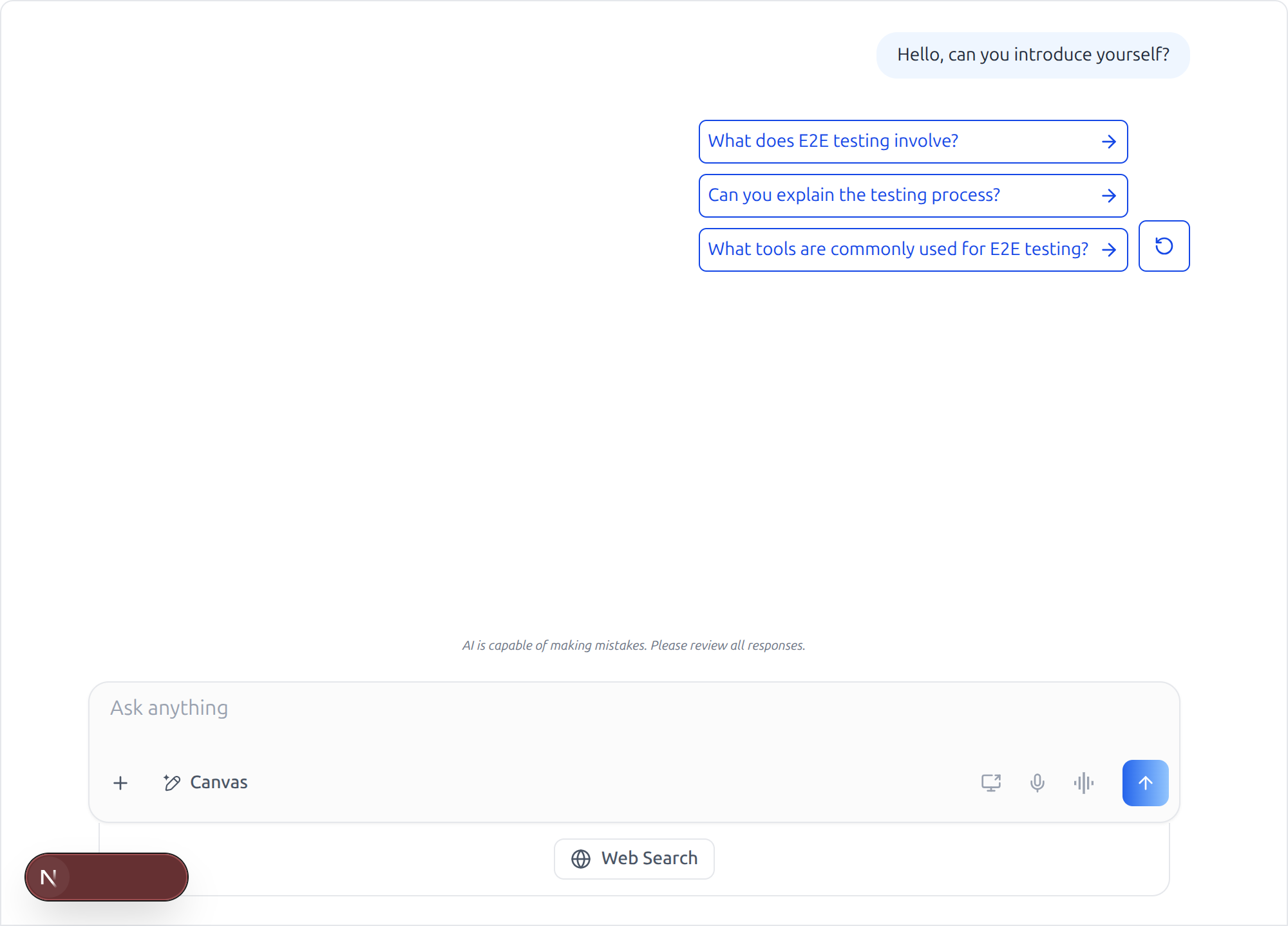
- send a message → "I Accept" the User Agreement → bubble + "is
generating…" indicator;
- voice: record → transcription clears "Processing…" (if it
hangs, the StrictMode workaround isn't applied or
<Chat> is
remounting);
- prompt gallery: open then close → app still clickable (guard
working);
- resume/new (if wired): history link loads the conversation;
"new chat" starts empty.
CLI Integration (proposal — not yet implemented)
Automating this skill would: install the Step 3 deps
(incl. @iblai/agent-ai); patch providers (wrap ServiceWorkerProvider
skip, pass basePath); copy public/sw.js; add the
Service-Worker-Allowed header + reactStrictMode:false; register the
Step 5 reducers (detecting + renaming host key collisions); scaffold the
Step 6 route; drop in RadixPointerEventsGuard; and no-op if already
added.
Brand guidelines: BRAND.md
