# @three-ws/sign-language
<!-- three.ws:badges -->
[](https://github.com/nirholas/sign-language/stargazers) [](https://github.com/nirholas/sign-language/blob/HEAD/LICENSE) [](https://github.com/nirholas/sign-language/commits) [](https://github.com/nirholas/sign-language/pulls) [](https://github.com/nirholas/sign-language/blob/HEAD/AGENTS.md)
<!-- /three.ws:badges -->
American Sign Language for 3D avatars. Compile text into one continuous signed animation clip: words the lexicon knows are signed from anatomical descriptions (handshape, place on the body, movement), everything else fingerspells with the manual alphabet, and non-manual facial markers ride along. Zero runtime dependencies: no three.js, no DOM, no network. The same module runs in a browser, in Node, and in a test runner.
This package is the published build of the engine that powers [three.ws/sign-language](https://three.ws/sign-language) and the `/docs/sign-language` feature. Clips come out as the same clip-JSON document the three.ws animation library serves, so they retarget onto any humanoid rig with finger bones.
## Install
```bash
npm i @three-ws/sign-language
```
## Compile a sentence
```js
import { compileUtterance, signLookup, signGloss } from '@three-ws/sign-language';
const signs = signLookup({ dominant: 'Right' });
const { clip, signed, spelled } = compileUtterance('happy to meet you', { signs });
console.log(signed); // words signed from the lexicon
console.log(spelled); // words that fingerspelled instead
console.log(signGloss('happy')); // human-readable description of the sign
console.log(clip.duration, clip.tracks.length);
```
`clip` is a plain three.js `AnimationClip` JSON document. Parse it with `AnimationClip.parse(clip)` in a three.js app, or feed it to the three.ws animation pipeline as-is.
A runnable version of this lives in [example/compile-utterance.mjs](example/compile-utterance.mjs):
```bash
node example/compile-utterance.mjs "happy to meet you"
```
## Speak alongside chat
`SignSpeaker` sequences utterances for a live conversation (chat replies, captions) with the pacing constants in `CHAT_TIMING`, and `estimateDuration` / `utteranceWords` let a UI plan ahead without compiling:
```js
import { SignSpeaker, estimateDuration } from '@three-ws/sign-language';
// `manager` is anything with { injectClip(name, clip, opts), playOnce(name, opts) }:
// the three.ws AnimationManager, or a thin adapter over your own player.
const speaker = new SignSpeaker({ manager, dominant: 'Right' });
console.log(estimateDuration('nice to meet you')); // seconds, before compiling
const { signed, spelled } = await speaker.speak('nice to meet you'); // resolves when the signing ends
speaker.cancel(); // abandon an utterance; a newer speak() supersedes an older one
```
`SignSpeaker` needs a manager: it drives an avatar. To get a clip without one, call `compileUtterance` directly, as above.
## The five layers
The public surface is organised the way the engine is built; import from any layer:
| Layer | Exports | What it is |
| --- | --- | --- |
| speak | `SignSpeaker`, `compileUtterance`, `estimateDuration`, `utteranceWords`, `CHAT_TIMING` | Text in, one continuous signed clip out, with no seam between signed and fingerspelled words |
| spell | `buildFingerspellingClip`, `letterPose`, `LETTER_SHAPES`, `DEFAULT_TIMING`, `normalizeWord` | The manual alphabet: A-Z, 0-9, the traced J and Z, the double-letter bounce |
| lexicon | `SIGNS`, `SIGNABLE_WORDS`, `buildSignClip`, `lookupSign`, `signGloss`, `signLookup`, `DEFAULT_SIGN_TIMING` | The sign vocabulary, each entry a set of phases described anatomically |
| author | `HANDSHAPES`, `applyHandshape`, `SignTimeline`, `place`, `direction`, `poseHand`, `posePhase`, `faceWeights`, `mirrorPhase`, `neutralPose`, `restingPose`, `SIGNING_BONES`, `FACE_MARKERS` | The layer signs are written in: handshapes, body anchors, contact solving, non-manual markers, timelines |
| kinematics | `Pose`, `solveArm`, `anchorPoint`, `fingerBones`, `fingerTip`, `wristPosition`, `restWorld`, `ANCHORS`, `FINGERS`, `FINGER_JOINTS` and friends | Canonical-skeleton math: forward kinematics, two-bone arm IK, hand geometry |
Add a word to the vocabulary by authoring phases in the same anatomical vocabulary `SIGNS` uses and passing your extended lookup to `compileUtterance`; nothing else changes.
## Play a clip on an avatar
On three.ws every humanoid avatar plays these clips natively. In your own three.js app:
```js
import { AnimationClip, AnimationMixer } from 'three';
const parsed = AnimationClip.parse(clip);
const mixer = new AnimationMixer(avatarRoot);
mixer.clipAction(parsed).play();
```
Track names target the canonical Avaturn-style bone set (`Hips`, `RightHand`, `RightHandIndex1`, ...). A rig with different bone names retargets through the three.ws pipeline (`src/glb-canonicalize.js` + `src/animation-retarget.js` in the [monorepo](https://github.com/nirholas/three.ws)), which maps Mixamo, VRM, Daz, MakeHuman and other conventions automatically.
## What this is, and what it is not
Read this before shipping it to users.
This renders **English word order using an ASL lexicon and the manual alphabet**. It does not produce ASL grammar, which has its own syntax, topic-comment structure, spatial reference, and classifier system. A fluent signer will recognise the vocabulary and read the sentence; they will also recognise that it is not native ASL. That is a deliberate, honest limit of a text-driven renderer, not a bug to file.
Practical consequences:
- **Present it alongside text, not instead of it.** It is assistive presentation, not a certified interpreter, and it should never be the only channel for anything that matters (safety information, legal terms, medical instruction).
- **Fingerspelling is the honest fallback.** When a word is not in the lexicon the compiler spells it rather than guessing at a similar sign. A wrong sign reads as a different word; a spelled one reads as a spelled word.
- **Have Deaf signers review anything user-facing.** `signGloss()` returns each sign's plain-English description precisely so a reviewer who does not read code can audit the vocabulary.
- **Non-manual markers carry grammar.** Brow position distinguishes a yes/no question from a wh- question, so stripping the face lanes to save tracks changes meaning rather than just fidelity.
## Development
The package is a thin published surface over the monorepo engine (`src/sign-*.js` at the repo root):
```bash
npm run build # bundle src re-exports into dist/index.mjs (esbuild, no deps)
npm test # node --test: guards the published surface + dependency-freeness
npm run example # compile "happy to meet you" to example/utterance.clip.json
```
Both `npm test` and `npm run example` read `dist/`, so each rebuilds it first
(`pretest` / `preexample`): a fresh clone runs them with no extra step.
Deep engine coverage lives in the monorepo suite (`tests/sign-rig`, `sign-clip`, `sign-dictionary`, `fingerspelling`, `sign-speech`, `sign-goldens`, `sign-linguistics`).
## Related
- Live feature and docs: [three.ws/sign-language](https://three.ws/sign-language), [three.ws/docs/sign-language](https://three.ws/docs/sign-language)
- Tutorial: [Sign with your avatar](https://three.ws/docs/tutorials/sign-with-your-avatar)
- License: [LICENSE](LICENSE)
<!-- three.ws:growth -->
## Support the project
If sign-language saves you time, **[star it on GitHub](https://github.com/nirholas/sign-language)**. Stars are how other developers and AI agents find the repositories worth trusting, and they cost you one click.
Know someone who would use it? [Post on X](https://twitter.com/intent/tweet?text=sign-language%3A%20American%20Sign%20Language%20for%203D%20avatars&url=https%3A%2F%2Fgithub.com%2Fnirholas%2Fsign-language) · [Share on Bluesky](https://bsky.app/intent/compose?text=sign-language%3A%20American%20Sign%20Language%20for%203D%20avatars%20https%3A%2F%2Fgithub.com%2Fnirholas%2Fsign-language) · [Share on LinkedIn](https://www.linkedin.com/sharing/share-offsite/?url=https%3A%2F%2Fgithub.com%2Fnirholas%2Fsign-language) · [Submit to Hacker News](https://news.ycombinator.com/submitlink?u=https%3A%2F%2Fgithub.com%2Fnirholas%2Fsign-language&t=sign-language%3A%20American%20Sign%20Language%20for%203D%20avatars) · [Share on Reddit](https://www.reddit.com/submit?url=https%3A%2F%2Fgithub.com%2Fnirholas%2Fsign-language&title=sign-language%3A%20American%20Sign%20Language%20for%203D%20avatars)
## Built for AI agents too
Coding agents and LLM tooling can read this repo directly: [AGENTS.md](./AGENTS.md), [llms.txt](./llms.txt), [llms-full.txt](./llms-full.txt). Point an agent at `https://github.com/nirholas/sign-language` and it has the context it needs.
## More from the same author
- [All repositories by nirholas](https://github.com/nirholas/nirholas#readme): the full catalog, grouped by topic
- [three.ws](https://three.ws): the platform for 3D AI agents with Solana wallets, a skill marketplace and x402 payments
- Questions or ideas: [open an issue](https://github.com/nirholas/sign-language/issues) or [start a discussion](https://github.com/nirholas/sign-language/discussions)
## Contributors
[](https://github.com/nirholas/sign-language/graphs/contributors)
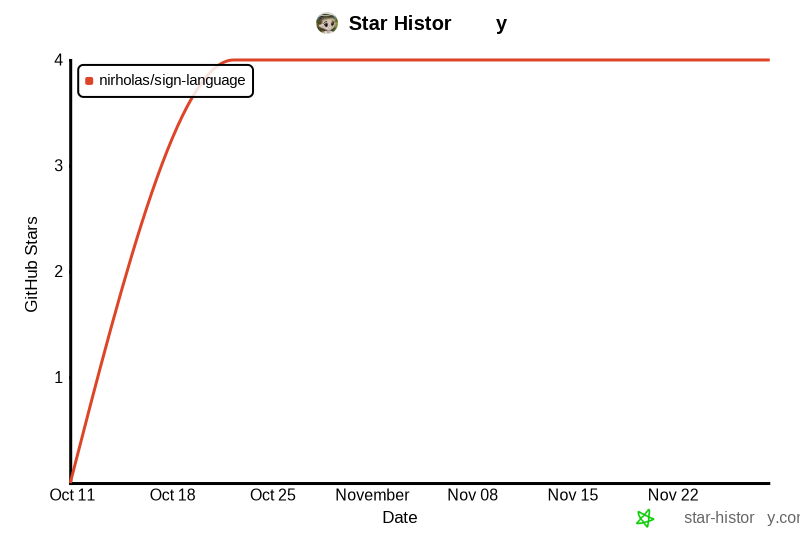
## Star history
[](https://www.star-history.com/#nirholas/sign-language&Date)
<!-- /three.ws:growth -->
<!-- three.ws:ecosystem -->
## Part of three.ws
[three.ws](https://three.ws) is a platform for 3D AI agents with Solana wallets: avatars, a skill marketplace, x402 payments and more than seventy MCP servers. `@three-ws/sign-language` is one package from it.
- Documentation site: https://nirholas.github.io/sign-language/
- npm: https://www.npmjs.com/package/@three-ws/sign-language
- Canonical source: https://github.com/nirholas/three.ws (this repository is a generated mirror of `packages/sign-language`)
- Agent-readable summary: [llms.txt](./llms.txt) and [AGENTS.md](./AGENTS.md)
- Issues and ideas: https://github.com/nirholas/sign-language/issues
<!-- /three.ws:ecosystem -->