# Sherwood
**Halt-aware lending against tokenized equities on Robinhood Chain.**
Robinhood Chain (`eip155:4663`) carries 254 tokenized equities with real liquidity: SPY alone holds
$8.5M of on-chain liquidity against $119M of daily volume, alongside NVDA, AAPL, TSLA, GLD, SGOV and
250 others. It carries no price oracle of any kind. Nothing on the chain can lend, margin, or settle
a derivative against a stock, because nothing can safely say what a stock is worth.
Sherwood is that layer, and the lending markets that prove it works.
- **[docs/oracle.md](docs/oracle.md)** how the price is decided, and why neither source can move it alone
- **[docs/halts.md](docs/halts.md)** what happens when the issuer pauses a token, and why it matters more than it sounds
- **[docs/markets.md](docs/markets.md)** supplying, borrowing, liquidating
- **[docs/baskets.md](docs/baskets.md)** diversifying halt risk rather than returns
- **[docs/deployment.md](docs/deployment.md)** deploying and operating the whole thing
- **[docs/architecture.md](docs/architecture.md)** the map
---
## The three things that make this different
### 1. The settlement price is the one a liquidator can realise
A tokenized share is not the share. It trades 24/7 on a chain; the underlying trades for six and a
half hours on a weekday. Every lending protocol has to pick which price it believes, and both obvious
answers are wrong.
Sherwood settles on the **Uniswap TWAP**, because a liquidator seizes tokens and sells them into a
pool on this chain, and what they realise there is what makes a liquidation solvent. A quorum of
reporters attests the real exchange price, and that attestation is used **only as a bound**.
Manipulate the pool and it walks away from the attestation. Compromise the reporters and they walk
away from the pool. Either way the feed goes dark rather than picking a winner. This inverts the usual
oracle: the trustless source decides, and the trusted one can only ever refuse to confirm, so a
compromised signer cannot mint value out of nothing.
The bands are measured, not guessed. Across all 38 listed equities the on-chain token tracks its
underlying to a **median of 65 basis points** and a **90th percentile of 163**:
```
$ pnpm --filter @sherwood/reporter exec tsx src/verify.ts
symbol on-chain exchange deviation
SGOV 100.43 100.43 0bps
SPY 774.08 773.17 +12bps
AAPL 327.72 328.21 -15bps
NVDA 229.94 228.45 +65bps
TSLA 369.71 376.37 -177bps
LULU 100.12 121.77 -1778bps outside both bands
...
37 priced, median deviation 65bps, 90th percentile 163bps
```
LULU is the case the rule exists for: a genuine 18% dislocation between the token and the share. The
oracle refuses to price it, and no market can lend against it, which is the correct answer.
### 2. A halted token cannot be liquidated at any price, so the market stops charging for the time
Every Robinhood stock token can be paused by its issuer. While it is, `transfer` reverts, so
collateral cannot be seized. A liquidation is not discouraged, it is impossible.
A lending protocol built for assets that never stop accrues interest through a two-day halt against
borrowers who could not repay or top up, clears nothing because nobody can liquidate, and then at the
unpause has its entire book underwater at once, at a price that gapped while nobody could act. The
first liquidator in the block takes all of it.
While collateral is unpriceable, a Sherwood market:
- **stops accruing interest entirely**, so a halt costs the borrower nothing;
- **refuses new borrows and collateral withdrawals**, because health cannot be evaluated;
- **keeps repayment and supply open**, because they only ever reduce risk;
- **lets depositors withdraw**, because a halt is not a reason to trap people who are owed money.
When the price returns, the **liquidation bonus ramps from zero** over the grace window. At the first
second there is no profit in liquidating anyone, so nobody does, and a borrower who was locked out
gets a real chance to cure at the new price. By the end of the window the full incentive is back.
### 3. Corporate actions are read off the token, not from a human
Robinhood's stock tokens publish a `uiMultiplier`, and publish the *next* one along with the second it
takes effect. That is advance, on-chain notice of a stock split, which no mainnet price feed has. It
is used twice:
- **Before it lands.** A scheduled *fall* in the multiplier is a scheduled fall in what a raw token is
worth, so it is applied to collateral the moment it is announced. Nobody borrows against value
already booked to disappear. A scheduled rise is not credited early.
- **Just after it lands.** For one TWAP window the moving average straddles the jump and is wrong by
up to the split ratio. The feed serves nothing at all. A protocol that missed this would liquidate
its entire book at a tenth of fair value the morning after a reverse split.
---
## Verification
Everything below runs against the live chain or a fork of it. No mocks in the integration path.
```
$ forge test --root contracts 61 passed
$ RHC_RPC_URL=... forge test --match-contract Fork 6 passed
$ pnpm -r test 54 passed
$ node scripts/e2e.mjs end to end on a fork
$ node scripts/demo.mjs --check the running stack, every surface
```
The fork suite reads the real SPY token, the real beacon every tokenized equity proxies to, and the
real SPY/USDG pool, and asserts the oracle's arithmetic lands on the price the chain is quoting:
```
[PASS] test_livePoolDecodesToARealisticSharePrice()
live SPY share price (USD): 774.23082700
[PASS] test_twapAgreesWithSpotSqrtPrice()
[PASS] test_liveStockTokenExposesTheAssumedSurface()
[PASS] test_marketOnLivePairIsHealthyAtRest()
```
`scripts/e2e.mjs` forks the chain and drives the whole protocol against real tokens: it brings the
feed live with a quorum-signed quote, proves an out-of-band quote disables rather than reprices,
borrows against real SPY, halts the token by writing the same storage slot `pause()` writes, verifies
that three days of halt move the debt by zero, confirms borrowing and liquidation are both refused,
watches the bonus ramp 0 to 175 to 700 basis points, moves the real pool with real swaps, and
liquidates the position that makes unhealthy.
---
## Layout
| Path | What it is |
|---|---|
| `contracts/` | Foundry project: oracle, market, factory, basket, rate model |
| `packages/sdk/` | Typed client, the generated asset registry, and risk math that mirrors the contracts |
| `apps/reporter/` | Fetches real equity quotes, signs them, posts a quorum |
| `apps/keeper/` | Liquidation bot that understands the halt shield |
| `apps/api/` | Read API, and it serves the app |
| `apps/web/` | Landing page and the working platform, no bundler |
| `scripts/` | Pool discovery, ABI generation, end-to-end, and the local demo |
### Contracts
| Contract | Responsibility |
|---|---|
| `SherwoodOracle` | Pool TWAP bounded by attested quotes, halt and corporate-action aware |
| `SherwoodMarket` | One isolated market. No owner, no upgrade path, no pause |
| `SherwoodFactory` | Deterministic deployment; a market's address is a commitment to its terms |
| `KinkedIrm` | Two-slope rate curve, immutable once deployed |
| `SherwoodBasket` | Fixed-weight equity basket whose redemptions survive a halted constituent |
| `SherwoodBasketOracle` | Prices a basket on what is visible, and says how much has gone dark |
---
## Running it
```bash
pnpm install
forge build --root contracts
forge test --root contracts
```
### Run the whole thing locally, in one command
```bash
pnpm demo
```
That forks Robinhood Chain, deploys the protocol, points it at the real SPY and NVDA pools, creates
two markets with different terms, opens a position in each, and serves the API and the app against it.
Open the URL it prints. Every price on the page is the price the exchange is printing right now,
because the chain underneath is a copy of the real one.
```
┌──────────────────────────────────────────────────────────────┐
│ Sherwood is running at http://localhost:8734 │
└──────────────────────────────────────────────────────────────┘
SPY 0x99ECcB3A… $ 774.31/share LTV 70% live
NVDA 0x4C1a72bE… $ 230.33/share LTV 65% live
```
`pnpm demo -- --halt` starts with SPY paused, so the halt shield is visible in the interface.
`pnpm demo -- --check` boots everything, asserts every surface answers, and exits.
### Other things worth running
```bash
# live equity quotes for every listed asset
pnpm --filter @sherwood/reporter quote
# how far each token sits from its underlying, right now
pnpm --filter @sherwood/reporter exec tsx src/verify.ts
# the whole protocol, end to end, on a fork of the real chain
pnpm e2e
```
Deploying and operating: **[docs/deployment.md](docs/deployment.md)**.
### Creating a market
A market's address is the hash of its terms, so anyone can compute where a given set of risk
parameters must live before putting a dollar into it, and the same terms cannot be deployed twice.
```bash
FACTORY=0x... COLLATERAL=0x117cc2133c37B721F49dE2A7a74833232B3B4C0C \
LOAN_TOKEN=0x5fc5360D0400a0Fd4f2af552ADD042D716F1d168 \
ORACLE=0x... IRM=0x... LLTV=700000000000000000 \
forge script script/CreateMarket.s.sol:CreateMarket --root contracts \
--rpc-url $RHC_RPC_URL --broadcast
```
There is no allowlist. A permissioned factory would let whoever holds the key decide what the world is
allowed to borrow against; curation belongs in front ends and in vaults that choose markets.
---
## What is deliberately not here
- **No governance token, no treasury, no fee switch turned on.** The fee parameter exists per market
and every market shipped so far sets it to zero.
- **No admin on a market.** Parameters are immutable from construction. The only way to change terms
is to deploy a new market, which has a different address, which nobody is moved into silently.
- **No rebalancing inside baskets.** They never trade, so they cannot be sandwiched or drained through
a rebalance, and they need no oracle to mint or redeem.
- **No cross-collateral.** Isolation is the point: one halted ticker's frozen bad debt should not
reach depositors who never wanted exposure to it.
The oracle does have an owner, and that is a real trust assumption: it can configure assets and rotate
reporters. It cannot set a price, cannot bypass the deviation band, and cannot touch a market's terms
or anyone's position. See [docs/oracle.md](docs/oracle.md#trust).
## Licence
MIT.
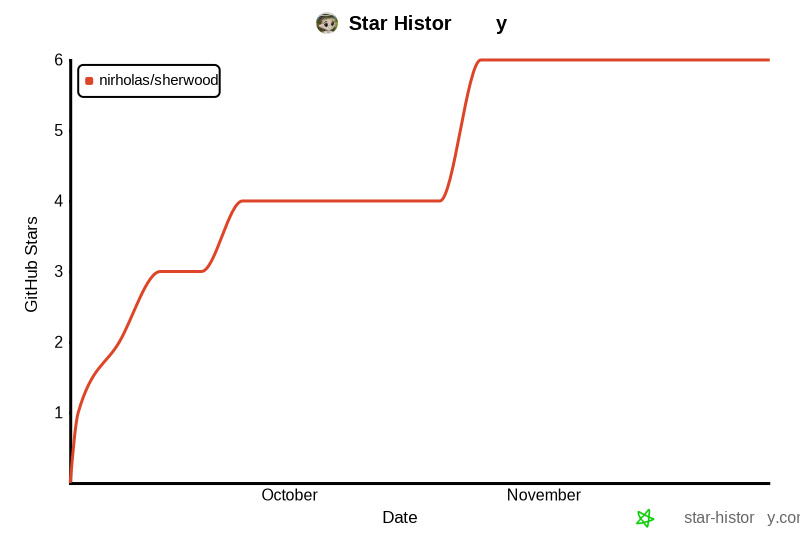
## Star History
[](https://www.star-history.com/#nirholas/sherwood&Date)
<!-- nirholas:watermark -->
---
<p align="center">
Built by <a href="https://github.com/nirholas"><b>nirholas</b></a> · <a href="https://x.com/nichxbt">@nichxbt</a> · <a href="https://github.com/nirholas">github.com/nirholas</a>
</p>
<!-- /nirholas:watermark -->