
[](https://dev.azure.com/truera/trulens/_build/latest?definitionId=8&branchName=main)


[](https://www.trulens.org/getting_started/)
[](https://deepwiki.com/truera/trulens)
# 🦑 TruLens
**TruLens finds where your agent fails and where you can cut cost without losing
quality.** Open source, OpenTelemetry-native.
Instrument any app with a decorator, score every step with LLM judges that explain
themselves, then compare versions and ship the one that earns it. Tracing is
OpenTelemetry-native, so a trace is portable to any OTLP backend, and evaluations
run either as traces land or over a dataset after the fact.
Read more about the core concepts behind TruLens including
[Metrics](https://www.trulens.org/getting_started/core_concepts/feedback_functions/),
[the RAG Triad](https://www.trulens.org/getting_started/core_concepts/rag_triad/),
and [Honest, Harmless and Helpful Evals](https://www.trulens.org/getting_started/core_concepts/honest_harmless_helpful_evals/).
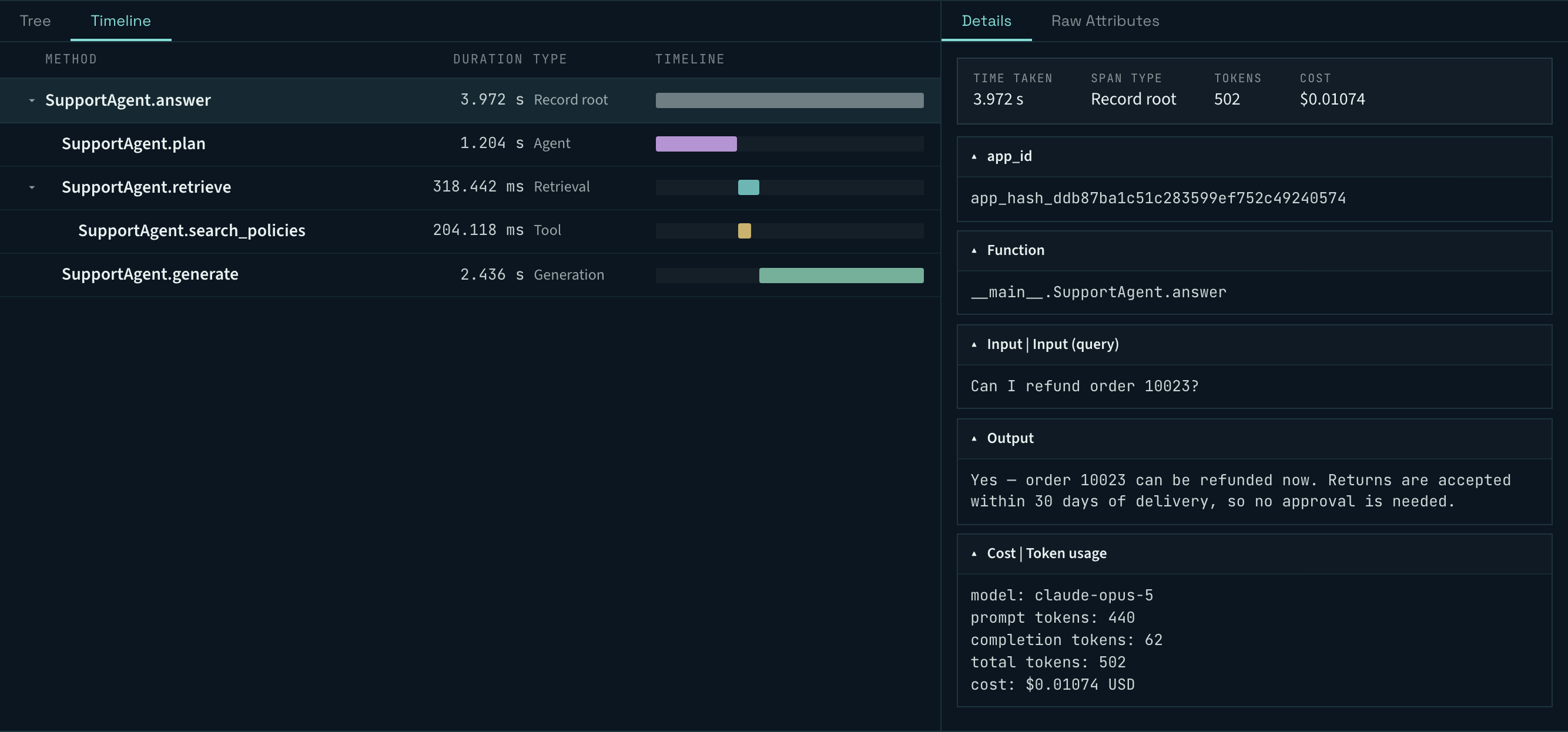
## Trace every step
Latency, inputs, outputs, tokens and cost, recorded per step, so a bad answer has
a traceable cause rather than a vibe.
## Compare versions, ship the frontier
Scores, latency and cost per app version, so the tradeoff is visible instead of
guessed. The cheapest version is often not the worst one.

## Don't take our word for it
TruLens judges are graded against human annotations, out of the box.
| Result | Metric | Detail |
|--------|--------|--------|
| **95%** | Agent errors caught with Agent GPA on TRAIL/GAIA | 267 of 281 human-annotated errors, against 55% for the baseline trace judge ([arXiv:2510.08847](https://arxiv.org/abs/2510.08847)) |
| **0.81** | Groundedness F1 on LLM-AggreFact | Ahead of a fine-tuned proprietary model, Bespoke-MiniCheck-7B, on F1, precision and recall over an 11,000-example holdout ([RAG triad benchmarks](https://www.snowflake.com/en/engineering-blog/benchmarking-LLM-as-a-judge-RAG-triad-metrics/)) |
| **0.93** | Context relevance NDCG@5 | First of five tools on three of four ranking metrics, ahead of WandB Weave, RAGAS, DeepEval and UpTrain ([AIMultiple, 23 March 2026](https://aimultiple.com/rag-evaluation-tools)) |
| **4.2:1** | Context relevance adversarial win-loss | Scored the correct passage over a near-copy with one fact swapped 4.2 times for every reversal, against 3.3:1 for the next best tool ([AIMultiple](https://aimultiple.com/rag-evaluation-tools)) |
## Adopted by AI teams at
Walmart Global Tech, Cisco, J.P. Morgan Chase, Equinix, VMware by Broadcom,
Hitachi Digital Services, Thomson Reuters, phData, HID Global and others. See
[ADOPTERS.md](https://github.com/truera/trulens/blob/main/ADOPTERS.md).
## Installation and Setup
Install the trulens pip package from PyPI.
```bash
pip install trulens
```
Install with a specific LLM provider for feedback evaluation:
```bash
pip install trulens trulens-providers-openai # OpenAI / Azure OpenAI
pip install trulens trulens-providers-orcarouter # OrcaRouter (OpenAI-compatible gateway)
pip install trulens trulens-providers-litellm # LiteLLM (Anthropic, Cohere, Mistral, …)
pip install trulens trulens-providers-google # Google Gemini
pip install trulens trulens-providers-bedrock # AWS Bedrock
pip install trulens trulens-providers-cortex # Snowflake Cortex
pip install trulens trulens-providers-huggingface # HuggingFace
pip install trulens trulens-providers-langchain # LangChain models
```
Install with a specific app framework integration:
```bash
pip install trulens trulens-apps-langchain # LangChain / LangGraph
pip install trulens trulens-apps-llamaindex # LlamaIndex
```
## Quick Usage
Walk through how to instrument and evaluate a RAG built from scratch with
TruLens.
[](https://colab.research.google.com/github/truera/trulens/blob/main/examples/quickstart/quickstart.ipynb)
## Key Features
### 🔭 OpenTelemetry-based tracing
TruLens instrumentation is built on [OpenTelemetry](https://opentelemetry.io/).
Every function call, LLM generation, retrieval, and tool invocation is captured
as a structured OTEL span. This makes TruLens interoperable with existing
observability infrastructure — export traces to Jaeger, Grafana Tempo, Datadog,
New Relic, or any OTLP-compatible backend.
```python
from trulens.core.otel.instrument import instrument
from trulens.otel.semconv.trace import SpanAttributes
class MyRAG:
@instrument(
span_type=SpanAttributes.SpanType.RETRIEVAL,
attributes={
SpanAttributes.RETRIEVAL.QUERY_TEXT: "query",
SpanAttributes.RETRIEVAL.RETRIEVED_CONTEXTS: "return",
},
)
def retrieve(self, query: str) -> list: ...
```
### 🤖 Agentic evaluations
Seven purpose-built evaluators for agentic systems — each measuring a distinct
aspect of agent behavior:
| Evaluator | What it measures |
|-----------|-----------------|
| LogicalConsistency | Reasoning coherence; flags hallucinations and unsupported assertions |
| ExecutionEfficiency | Redundant steps, unnecessary retries, wasted computation |
| PlanAdherence | Whether execution followed the stated plan |
| PlanQuality | Intrinsic plan quality — strategy, not outcome |
| ToolSelection | Right tool chosen for each subtask |
| ToolCalling | Argument validity and output interpretation |
| ToolQuality | External tool/service reliability |
### 📊 Batch and inline evaluation
Run evaluations alongside your app, on existing data, or in offline batch mode:
```python
# Inline — evaluate as the app runs
with tru_recorder as recording:
response = my_app.query("What is TruLens?")
# Batch — evaluate a pre-collected dataset using the Run API
from trulens.core.run import RunConfig
run_config = RunConfig(
run_name="batch_eval_v1",
dataset_name="eval_questions",
source_type="TABLE",
dataset_spec={"input": "QUESTION"},
invocation_max_workers=8,
metric_max_workers=4,
)
run = tru_app.add_run(run_config=run_config)
run.start()
run.compute_metrics([relevance, groundedness])
```
### 🔌 MCP support
Instrument [Model Context Protocol](https://modelcontextprotocol.io/) tool calls
with the `MCP` span type to capture tool name, arguments, output, and latency:
```python
@instrument(span_type=SpanAttributes.SpanType.MCP)
def call_mcp_tool(self, tool_name: str, arguments: dict) -> str: ...
```
### 🎯 Selector API
Target any span attribute for evaluation using the flexible Selector API:
```python
from trulens.core import Metric, Selector
f_context_relevance = Metric(
name="Context Relevance",
implementation=provider.context_relevance,
selectors={
"question": Selector.select_record_input(),
"context": Selector.select_context(collect_list=False),
},
)
```
## Supported LLM Providers
| Provider | Package |
|----------|---------|
| OpenAI / Azure OpenAI | `trulens-providers-openai` |
| LiteLLM (Anthropic, Cohere, Mistral, and more) | `trulens-providers-litellm` |
| Google Gemini | `trulens-providers-google` |
| AWS Bedrock | `trulens-providers-bedrock` |
| Snowflake Cortex | `trulens-providers-cortex` |
| HuggingFace | `trulens-providers-huggingface` |
| LangChain models | `trulens-providers-langchain` |
| OrcaRouter (OpenAI-compatible gateway) | `trulens-providers-orcarouter` |
## 💡 Contributing & Community
Interested in contributing? See our [contributing
guide](https://www.trulens.org/contributing/development/) for more details.
The best way to support TruLens is to give us a ⭐ on
[GitHub](https://www.github.com/truera/trulens) and join our [discourse
community](https://snowflake.discourse.group/c/ai-research-and-development-community/trulens/97)!
README-Quelldatei lesen